
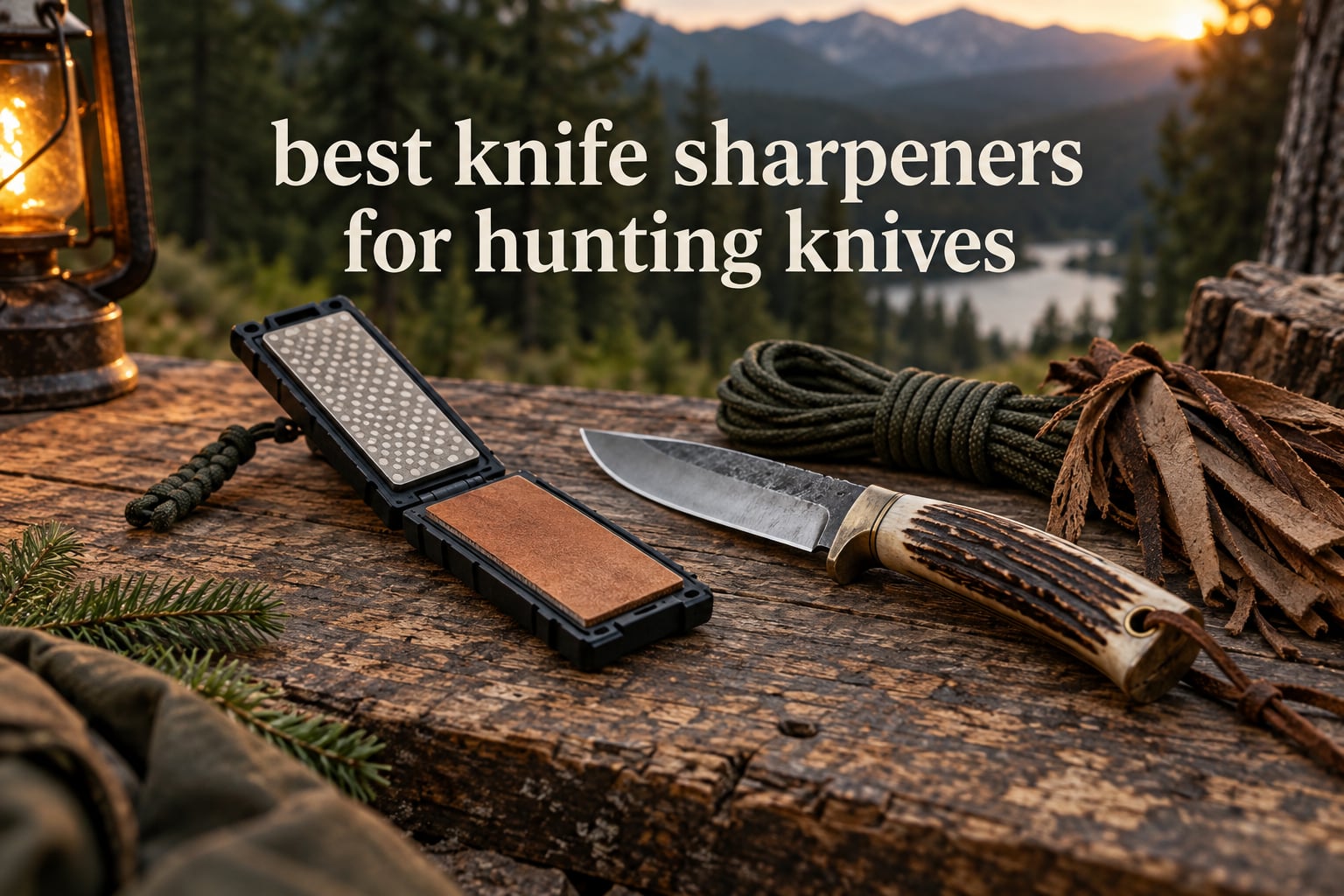
A dull hunting knife is a dangerous hunting knife. A blade that has gone blunt after a morning of hide, bone and blood needs noticeably more force to part anything, and force is exactly what makes a knife skate off a shoulder seam or slip out of a wet grip. The problem is timing: you rarely notice the edge is gone while the knife is in its sheath. You notice it at the tree line, on the first draw cut, with the light already fading.
That is why the best knife sharpeners for hunting knives are not really about peak sharpness on a bench. They are about having a correct, repeatable edge within reach of your pack. For most hunters the answer is the Work Sharp Guided Field Sharpener, because it puts coarse diamond, fine diamond, two ceramic stages and a leather strop in one self-contained unit with fixed 20 to 25 degree guides. It is the sharpener we keep within arm’s reach of the sleeping bag.
Our answer in one line: the Work Sharp Guided Field Sharpener is the best overall hunting knife sharpener for most people, the Work Sharp Benchstone is the most precise manual option, and the AccuSharp is the one to pack when you want the least weight and the least fuss.
On angles, here is the short answer most people are after. A general-purpose hunting blade wants 20 to 25 degrees per side. Twenty degrees gives a cleaner, slicing-oriented edge for caping and general camp work. Twenty-five degrees is the more forgiving choice for a hard-use fixed blade that will meet bone and shoulder blade. Drop to 15 degrees only for thin, delicate blades you value more for slicing than for abuse.
We worked through eight sharpeners on the blades we actually use: a 1095 fixed blade, an S30V skinner, a smaller caping knife and a gut hook. Nothing here is a lab edge measurement. It is what happened on a cutting board, on a length of rope and on a sheet of paper after a week in the woods. For the kitchen side of this topic, our picks for the best knife sharpeners for kitchen knives cover a different set of edges.
Top 3 Best Knife Sharpeners For Hunting Knives (October 2026)

Work Sharp Guided Field Sharpener
- 20 to 25 degree guides
- Five abrasive stages
- 135 g self-contained


Work Sharp Benchstone
- 400 and 800 grit diamond
- Fine ceramic stage
- Adjustable 20 and 25 degree guides
The Work Sharp Guided Field Sharpener wins because it does the whole job in one case, at a fixed angle, with no stones to keep flat. The AccuSharp is the fastest reset when an edge is merely tired rather than damaged, and the Work Sharp Benchstone is the pick if you want an edge you can refine to a fine finish at a workbench before the season starts.
The 8 Best Knife Sharpeners for Hunting Knives at a Glance
| Product | Specifications | Action |
|---|---|---|
| Work Sharp Guided Field Sharpener |
|
Check Latest Price |
| AccuSharp Knife Sharpener |
|
Check Latest Price |
 Smith’s Pocket Pal PP1 Smith’s Pocket Pal PP1 |
|
Check Latest Price |
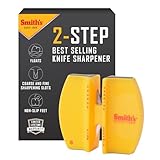 Smith’s CCKS 2-Step Sharpener Smith’s CCKS 2-Step Sharpener |
|
Check Latest Price |
 Smith’s DCS4 Diamond Combination Sharpener Smith’s DCS4 Diamond Combination Sharpener |
|
Check Latest Price |
| Work Sharp Benchstone |
|
Check Latest Price |
 Wicked Edge Venture WE20 Wicked Edge Venture WE20 |
|
Check Latest Price |
 Work Sharp Portable Pocket Sharpener Work Sharp Portable Pocket Sharpener |
|
Check Latest Price |
Two patterns stand out in that table. The tools that survive a season in a pack are small, self-contained and need no water, oil or assembly. The tools that produce the best finished edges are wider, because a wider stone or plate gives you more room to work on a long fixed blade. Most hunters end up owning one of each, and the buying guide below explains why.
How We Tested These Knife Sharpeners?
Every sharpener here went through the same protocol, and it is simple enough to repeat at home. We first put a deliberately dulled edge on the blade, either by working a hardwood board or by drawing the edge across a belt sander. Then we sharpened using only the instructions in the manual, timing ourselves rather than counting strokes, because a system that takes four careful minutes is a different tool from one that takes ten frantic minutes.
After sharpening we ran four checks in order. A paper test shows whether the tip is still crisp. An arm-hair test shows whether the edge is keen enough to catch hair cleanly. A rope test, cutting a twisted length of bank line, shows whether the tip is holding an acute point. Finally we cut a ripe tomato, which separates clean slices from a juicy mess better than almost anything else in a camp kitchen.
We also checked the things spec sheets skip. Does the tool need a flat surface, water or oil? Can it be used with cold hands? Does the angle guide stay put on a long fixed blade, or do the guide and the spine fight each other partway down? Those questions separated these eight tools more clearly than any published specification did.
Knife Sharpener Reviews for Hunting Knives
1. Work Sharp Guided Field Sharpener – Best Overall for Hunting Knives
Work Sharp Guided Field Sharpener, Compact Travel Knife Sharpener Tool
20-25 degree guides
5 abrasive surfaces
135 g
Self-contained, no setup
Pros
- Complete field system in one compact tool
- Five stages from coarse diamond to leather strop
- Grooved ceramic surface for fish hooks and small points
- No assembly
- water or oil needed
- Backed by a multi-year warranty
Cons
- Angle range is narrower than a full bench stone system
- Abrasive surfaces wear over time and are not warranty-covered
This is the unit that has stayed in our pack the longest. It opens, and everything you need is in one shell: removable diamond plates, a rotating ceramic honing rod that exposes coarse and fine surfaces plus a grooved section, and a leather strop. Nothing has to be carried separately, which matters more than it sounds, because a sharpener left in the vehicle is no use at the tree line.
The 20 to 25 degree setting is why it earns the top spot. Our 1095 fixed blade came off the diamond plate at an angle that cut paper cleanly and still held through a full evening of skinning, and the ceramic stages took that edge from merely sharp to sharp enough to be noticed. The strop is the step most people skip, and it is the difference between an edge that slices and an edge that feels finished.
The detail hunters appreciate most is the broadhead wrench hidden under the diamond plates. On an arrow season where the broadhead is the one tool with a short calendar, pulling the plates off and using the wrench on a flat rock or camp table is a genuinely useful two-minute job. The grooved ceramic section handles fish hooks and small pointed tools, which matters if one kit covers bowhunting and trout.
Hunters on longrangehunting.com describe the Work Sharp guided systems as the easiest they have ever used, and our experience lines up. The limitation is minor: the angle range is narrower than a dedicated bench stone setup, so a deliberately thin 15 degree edge is out of reach, and the abrasives wear eventually.
When this is the right sharpener?
This is the one for a hunter who carries a single fixed blade and a caping knife and wants one object to cover both. It is also the right answer for anyone who wants a repeatable angle without learning freehand stone work, because the guide does the angle thinking for you.
If your hunting involves processing a lot of meat in camp, the full stage coverage pays off. You can reset on the coarse plate, refine on the fine plate, clean up on the ceramic and strop before cutting, all in the same minute without moving location.
When this is the wrong sharpener?
It is not the right tool for restoring a badly damaged blade, for thinning an edge that is far too obtuse, or for producing a mirror finish on a collector piece. A bench stone worked carefully will beat it on finish.
For camp and trail work that difference hardly matters. What matters on day four of a trip is that the edge is consistent, and this one delivers that.
2. AccuSharp Knife Sharpener – Best Value for Quick Field Resets
AccuSharp Knife Sharpener, Ergonomic Comfortable Handle, Compact & Easy to Use, Restore and Hone Straight & Serrated Knives, White
Fixed 15 degree bevel
Reversible carbide blades
1.6 oz
Fits either hand
Pros
- Roughly ten seconds to a working edge
- Reversible carbide blades double the lifespan
- Handles straight and serrated blades
- Full-length guard protects fingers
- Cleans with soap and water
Cons
- Fixed 15 degree bevel is not ideal for thick blades
- Plastic housing feels light beside metal systems
- Leaves fine metal dust to wipe up
There is a job this tool does better than anything else in this roundup, and the job is resetting a tired edge in the middle of a task. You pull the blade through the slot a handful of times and the carbide blades put a usable edge back without interrupting what you were doing. No water, no stone, no flat surface, no cleanup beyond a wipe.
The 15 degree bevel is the specification that matters most. On a caping knife or a thin gutting blade it produces a keen, slicing edge in seconds. On a thick 1095 skinner it is not an angle you would choose deliberately, which is why we would not build a whole setup around it. Repeated use on a very thick blade removes more steel than you intended.
What we like most is the ergonomics in cold hands. The full-length guard keeps your hand away from the abrasive, and the body is wide enough to hold with gloves on. The carbide blades are reversible, and owners report years between replacements, so the running cost of this sharpener is effectively zero.
Our test confirmed the split personality. On the caping knife it hit paper and hair immediately. On the thick skinner it produced a working edge but not a refined one, and it left a fine grey dust on the blade that needs wiping before you stow it.
When this is the right sharpener?
Buy it for the truck, the saddlebag, the tackle box and the guest who will inevitably hand you a dull knife at the cook tent. At under two ounces with a guard that suits either hand, it is the sharpener you can hand to someone else without giving a lesson.
It is also a good companion to a guided system, because a guided tool handles reshaping and this one handles the small daily refresh between tasks.
When this is the wrong sharpener?
It is wrong for a thin, fine edge you care about, and for any blade where you want to control the geometry. A fixed angle and an aggressive carbide slot will, over enough uses, change the shape of the edge whether or not it needed it.
There is no strop here either, so you get a functional edge rather than a polished one. For most field tasks that is a fair trade. For a presentation blade it is not.
3. Smith’s Pocket Pal PP1 – Best for Serrations, Gut Hooks and Tiny Packs
Smith’s PP1 Pocket Pal Knife Sharpener Preset Carbide & Ceramic Stone Sharpeners Fold-Out Diamond Coated Rod Outdoor Hunting Knife & Hook Sharpener, Handheld, Compact, Lightweight, Multiuse
1 oz
3.5 inches long
Fold-out diamond rod
Handles serrations and gut hooks
Pros
- Three sharpening options in one small tool
- Diamond rod handles serrations
- gut hooks and fish hooks
- One ounce with a lanyard hole
- Carbide and ceramic stones are reversible and replaceable
- Needs no setup in the field
Cons
- Fold-out diamond rod is a tight fit and can crack at the hinge
- Ceramic stones cannot be reversed when worn
- Produces a working edge rather than a fine finish
This is the smallest serious sharpener in the roundup and the only one that made our pack lighter without making us nervous about it. It weighs one ounce, measures about three and a half inches, and clips to a keychain or lanyard. In a hunt where every ounce gets argued over, that is a real argument.
It gives three options rather than one. The coarse carbide slot resets a dull straight edge, the fine ceramic stones refine it, and the fold-out diamond rod is what makes it a hunting knife sharpener specifically. That rod is the tool for serrations, gut hooks and fish hooks, none of which a flat stone or a pull-through slot can touch without damage.
On our gut hook and on a serrated skinning blade the rod did the job cleanly and quickly. On a straight fixed blade the carbide slot brought a tired edge back to cutting in about a dozen passes, which is roughly what reviewers report. It is the pull-through approach, and it is fast, so the number of passes matters more here than on a guided system.
The honest weakness is the hinge. The fold-out rod seats tightly and owners report it can crack if the tool is dropped or forced. The carbide blades flip when they wear, but the ceramic stones cannot, so they are a consumable you eventually replace rather than rotate.
When this is the right sharpener?
It suits backpackers, anyone who fishes and hunts in the same season, and anyone whose knife has serrations or carries a gut hook. A rod-based sharpener is the only practical way to dress those teeth without destroying them.
It is also a good primary sharpener for a first hunting knife, because there is almost no technique to learn and it will not break if you drop it in a creek.
When this is the wrong sharpener?
It is wrong when edge quality matters more than pack weight, and wrong for a thick, hard steel blade that is already damaged, because a pull-through slot removes steel quickly with no way to control it.
It is also not suited to ceramic blades or large axes. Treat it as a trail tool and it is excellent.
4. Smith’s CCKS 2-Step Sharpener – Best Budget Backup Sharpener
Smith’s CCKS 2-Step Knife Sharpener – Yellow – 2-Step Preset Coarse & Fine Slots – Outdoor Handheld Knife Sharpener – Fishing, Hunting, Fillet, Pocket Knives – Compact Plastic Portable Keychain Tool
Coarse carbide plus fine ceramic
Preset fixed angle
Under 2 oz
Floats in water
Pros
- Two preset stages give a consistent repeatable angle
- Small enough for a pocket or tackle box
- Floats in water and has non-slip rubber feet
- Handles curved and reverse-curved blades
- Very inexpensive and easy to replace
Cons
- Single fixed angle of roughly 20-25 degrees
- Coarse carbide slot removes a lot of steel
- Ceramic rods load with metal particles
- Plastic body feels inexpensive
The reason this one makes the list is not performance. It is redundancy. It is small enough to keep several, cheap enough that losing one in a truck bed is a non-event, and simple enough to work with wet hands and no light. A lot of hunters end up with one in the pack, one in the vehicle and one at the camp kitchen table.
Two crossed tungsten carbide blades and two crossed ceramic rods are preset at fixed angles, so results are repeatable even when you are not paying attention. On our test blades it restored a genuinely dull edge in three to four strokes, and the ceramic stage produced a noticeably smoother finish than carbide alone.
Where it surprised us was on a curved gutting blade, the reverse-curved profile that is awkward to hold flat on a stone. The preset slot followed the curve without fuss and did not leave the thin tip hanging. That is a real advantage over manual stones in a beginner’s hands.
Two cautions belong in the same sentence. The angle is fixed at roughly 20 to 25 degrees and cannot be adjusted, and the carbide stage is aggressive, so experienced users advise using it sparingly on a fine edge. The ceramic rods also load with metal over time and resist cleaning.
When this is the right sharpener?
This is right for a hunter who wants a working edge and nothing more, on a budget, in a place where losing tools is a realistic event. It is also excellent for camp kitchen knives and for a curved blade you would struggle to keep flat on a stone.
Because it floats and has rubber feet, it is a good choice near water, where a dropped sharpener is a real possibility.
When this is the wrong sharpener?
It is wrong for anyone who wants a finished, refined edge or who cares about preserving blade geometry over decades. A fixed aggressive slot is a poor tool for a thin, valuable blade.
On very large fixed blades the section of edge nearest the handle may not reach the slot, so you sharpen in sections rather than in one stroke. If your hunting knife is long, choose a longer abrasive surface.
5. Smith’s DCS4 Diamond Combination Sharpener – Best Lightweight Field Stone
Smith’s DCS4 4” Diamond Combination Sharpener – Double Sided Stone – Outdoor Field Knife Sharpener – Fish Hook & Pointed Tools Micro Sharpener – Lightweight, Compact, Handheld
325 grit coarse and 750 grit fine
Double sided stone
Stored in its own handle
About 0.8 oz
Pros
- Two-stage diamond stone cuts fast and finishes keen
- Micro-tool pad and fish hook groove on each side
- Handle stores and protects the stone
- Thumb guard and lanyard loop for safe use
- Hard to break in a pack
Cons
- Heavier than slim pull-through sharpeners
- Diamond surface needs a break-in period
- Awkward technique for long fixed blades
- Can mark delicate blades if used carelessly
A stone in the field sounds like a contradiction until you handle this one. The rubber grip holds the double-sided stone, a thumb guard keeps your hand clear, and the stone detaches and slides into the handle for packing. The result is a real two-stage abrasive surface in a package smaller than most pull-through sharpeners.
The 325 grit coarse side removed steel quickly, which is what you want when an edge has been dulled by hide and bone rather than simply rolled. The 750 grit fine side then brought it to a finish that sliced paper on the first try. The interrupted diamond surface is designed to hold filings clear of the working area, and it cleaned up easily in practice.
Each side also carries a micro-tool sharpening pad and a groove for fish hooks and needles, so this is genuinely a multi-use field stone. It is a solid pick for a hunter who also fishes or who carries small pointed tools that a pull-through slot would chew up.
The learning curve is the honest trade. This is a stone you hold at an angle, not one you pull through, and the technique takes practice. Our first sessions on a fixed blade felt slower than a guided system, and the diamond surface needs a short break-in before it feels consistent. Long blades are awkward because the stone is short.
When this is the right sharpener?
It suits anyone who wants a genuine coarse-to-fine progression without carrying a full stone set, and anyone who wants one tool that handles knives, hooks and small pointed tools. Packing is easy, and unlike a leather strop it needs no conditioning.
It is also a good match for a fixed blade dulled by real work rather than mere use, because the coarse side has material to give.
When this is the wrong sharpener?
It is wrong for a complete beginner who wants zero technique, and wrong for a delicate or expensive blade, since an interrupted diamond surface can mark it if you are careless. Dry the stone before storing it.
It is also not a bench tool. There is no angle guide, so repeatability depends on your hands, and the short stone makes a long fixed blade a two-handed job.
6. Work Sharp Benchstone – Best Tabletop Precision for Hunting Knives
Work Sharp Benchstone Knife Sharpener, 3 sided for faster manual pocket or hunting knife sharpening
400 and 800 grit diamond plus ceramic
Adjustable 20 and 25 degree guides
Pivot-response base
2.4 oz
Pros
- Three-sided system indexes quickly between abrasives
- Guides set to 20 or 25 degrees and remove for freehand
- Pivot-response base follows blade curvature
- Compact enough for a bench or camp kitchen
- Replacement abrasives extend tool life
Cons
- Fixed stone size limits comfortable blade length
- Manual technique still takes practice on long blades
This is the pre-season tool. It is the sharpener you pull out on a bench a few weeks before the season, put a proper edge on every blade in your bag, and strop before each trip. Three surfaces index quickly: 400 grit diamond to restore, 800 grit diamond to refine, and a fine ceramic stone to finish.
What sets it apart is the guide system and the pivot-response base. The guides set to 20 or 25 degrees to match the edge a hunting blade should have, and the abrasive follows the curve of the blade to keep contact through the transition from edge to spine. Lock the pivot out and you have a rigid flat surface for a final flattening or stropping pass.
In our testing the difference showed up in finish rather than function. The guided angle produced a noticeably more consistent edge than a freehand pass on a flat stone, and the ceramic stage left an edge that cut paper and arm hair cleanly on the first attempt. Extra guides for 15 and 17 degrees are available separately if you own thin blades.
The limitation is size. The stone is short, so working the full length of a large fixed blade means overlapping strokes, and the technique still takes practice to keep consistent. Users who sharpen a whole collection by hand will like the guides; occasional sharpeners should expect a slow first session.
When this is the right sharpener?
It is right for the hunter who maintains several blades and wants consistency rather than speed, and for anyone who wants the option to sharpen freehand by removing the guides once they trust their hands. It is compact enough to double as a camp kitchen tool.
It is also the natural companion to a field unit, since you set the edge properly at the bench and then carry a small sharpener to maintain it through the season.
When this is the wrong sharpener?
It is wrong for a hunter who wants a no-practice tool, and wrong for very long blades such as a machete or a big bowie, where the short stone becomes the limiting factor. If you restore damaged edges regularly, a longer bench system would serve better.
Because extra guides and abrasives are add-ons, a hunter with several thin blades will spend more over time than the initial tool suggests. Know that before you commit to one angle only.
7. Wicked Edge Venture WE20 – Best for a Consistent 20 Degree Edge
Wicked Edge Venture™ WE20 Hand Held Angle Guided Knife Sharpener
Fixed 20 degree angle guide
500 grit diamond plus ceramic hone
Leather strop included
4 oz
Pros
- Fixed angle guide makes repeat sharpening foolproof
- Diamond and ceramic stages cover shaping and refining
- Leather strop gives a polished final edge
- Fits a pack
- toolbox or glove compartment
- Made in the USA with a multi-year warranty
Cons
- One fixed angle without extra guides
- Heavier than pull-through sharpeners
- Additional stones and guides sold separately
The premise is simple: commit to one angle, learn it once, never think about it again. The 20 degree guide is built in, and it comes with a 500 grit diamond stone, a fine ceramic hone and a leather strop. For a hunter who runs a thin, keen edge on a caping or gutting blade, that is a complete answer in one package.
The strop is what separates this from the other hand-held units here. After the diamond stage and the ceramic stage, a few passes on the leather produced the smoothest finished edge we got from any portable tool in this roundup. It is also where real refinement happens, rather than more grinding.
The 20 degree result on our thinner blade was clean and consistent, and repeatability was excellent because there is no user angle to get wrong. At four ounces it is heavier than a pull-through unit but still small enough for a pack, a toolbox or a glove compartment.
The constraint is that one angle is one angle. Guides for 15, 17 and 25 degrees are sold separately, as are finer stones, so a hunter with a thick fixed blade and a thin skinner is buying more than one product. Its review base is also the smallest in this list, so weigh the durability claims accordingly.
When this is the right sharpener?
It is right if you have settled on a 20 degree edge and want a portable tool that never deviates from it, and if you actually use the strop. It is also a good single tool for a hunter who wants a polished edge in the field rather than a merely functional one.
It suits thin, keen blades particularly well, because a 20 degree edge matches how those knives are actually used.
When this is the wrong sharpener?
It is wrong for a hard-use fixed blade that wants 25 degrees, and for a kit that includes axes, hatchets or a thick chopper, none of which the 20 degree guide is designed for. It is also unnecessary weight if you only need a quick reset.
If you think you will want a 25 degree backup edge, factor in the extra guide before committing.
8. Work Sharp Portable Pocket Sharpener – Best for Pack Weight
Work Sharp Portable Pocket and Hunting Knife Sharpener, WSGPS-W
20 degree guide on diamond plate
25 degree on ceramic rod
1.6 oz
No setup required
Pros
- Built-in angle guides for consistent results
- Small and light enough for a kill kit or glove box
- No assembly
- oil or water needed
- Both surfaces clean with soap and hot water
- Complete beginners report beating the factory edge
Cons
- Small handle is easy to nick fingers on
- Fingertip-only grip can strain the wrist
- Diamond plate feels rough before it breaks in
- Not aimed at collector mirror finishes
The smallest guided sharpener here, and the one that most directly answers a simple question: can a complete beginner beat the factory edge? Owners with no sharpening experience say yes, and our test on the caping knife agreed. The 320 grit diamond plate has a 20 degree guide and the fine ceramic rod has a 25 degree guide, so two stages cover shaping and honing with no setup.
At 1.6 ounces it disappears into a pocket, an elk kill kit, a truck tool box or a tackle box. It needs no water, no oil and no assembly, and both abrasive surfaces clean up with soap and hot water, which matters after a week of handling meat and blood.
What surprised us was how useful the two angles are. The 20 degree plate suits a thin blade and the 25 degree rod suits something tougher, so the tool covers more than its size suggests. The ceramic rod is also the right surface for a light touch of honing on a blade that is rolled rather than dull.
The ergonomics are the honest weakness. The handle is small, and holding it with fingertips tires after a few minutes and can lead to nicks if your grip slips. The diamond plate feels coarse before it breaks in, and no one buys this tool for a mirror finish on a collector blade.
When this is the right sharpener?
It is right for the hunter who wants guided results at the lowest size and weight in this list, and for anyone who wants to keep one in a vehicle, a day pack and a hunting knife sheath without thinking about it. Two preset angles cover most hunting knives.
It is also a genuinely good gift sharpener, because the guides remove the part of sharpening beginners get wrong.
When this is the wrong sharpener?
It is wrong for heavy restoring work, for long blades where the short abrasive surfaces leave too much to do by hand, and for anyone with hand or wrist trouble, because the grip demands a fingertip hold.
It is also not a stropping tool, so it cannot refine an edge to a polished finish. If you already own a guided system with a strop, this is a companion rather than a replacement.
How to Choose a Knife Sharpener for Hunting Knives?
Choosing between eight sharpeners is easy once you answer four questions honestly: where you will actually use it, what angle your blade wants, what steel it is made from, and how much steel you are willing to remove. Ignore any one of those and you will buy the wrong tool, because each one points at a different design.
Field, Camp or Bench – Where Will You Actually Sharpen?
Field sharpening is about pack weight, cold hands and no flat surface. Everything in that category needs to work one-handed, ideally without water or oil, and needs to be small enough that you do not leave it behind. The Smith’s Pocket Pal, at one ounce, is the extreme of that range.
Camp and kitchen sharpening can be more deliberate, because you have a table and time. A benchstone with a guide, or a double-sided field stone, fits here, because a table supplies the flat surface a small handheld stone would otherwise need.
Bench work is where you set edges properly before a season, and controlled-angle systems belong there because consistency matters more than speed when you might do twenty blades. If you are still choosing knives, our guide to the best hunting knives for field dressing covers the blade types that need the most attention.
What Edge Angle Does a Hunting Knife Want?
Twenty to 25 degrees per side is the working range for hunting knives. Below 15 degrees you gain slicing sharpness and lose chip resistance, a poor trade for a blade that meets bone. Above 30 degrees you gain durability and lose the clean push cut a caping blade depends on.
What angle gives the sharpest edge? The lowest angle you can reliably produce, which for most hunters is 20 degrees. What angle are most hunting knives sharpened at? Twenty to 25 degrees per side, with most factory edges already sitting somewhere in that band.
Is 15 or 20 degrees better? A 15 degree edge is noticeably sharper on paper and on a tomato, and meaningfully more fragile against bone and hard use. A 20 degree edge is the sensible default for most hunting knives. To find the angle your own blade already carries, coat the edge with a black marker, run the sharpener through once, and look at where the black line stops. The unsharpened black line marks your factory angle.
Steel and Hardness Change the Sharpener You Need
Hunting steels cluster in the 56 to 61 HRC range, and 58 to 60 is the common target because it balances edge retention against the brittleness that makes a very hard steel chip. 1095 and 52100 tend toward the lower-middle of that band, S30V and S90V sit harder, and common stainless hunting steels such as 3Cr13 sit lower still.
Harder steels are why diamond abrasive is the default choice throughout this list. Diamond plates, belts and wheels cut hard modern stainless quickly, while a soft natural stone works slowly on the same steel. A chipped 58 to 60 HRC edge is best restored on a fast diamond or belt system rather than coaxed along with a soft stone.
Softer steels are the opposite case. They sharpen easily on almost anything, which is why the inexpensive carbide tools here work perfectly well on many hunting knives, and why the damage they cause is usually about geometry rather than difficulty.
Guided vs Freehand vs Pull-Through
Guided systems hold the angle for you. They remove the hardest part of sharpening for a beginner and produce repeatable results, at the cost of some speed and sometimes the ability to change angle. Freehand stones give complete control and unlimited angles, and they demand practice. Pull-through systems are fast, cheap and need no skill, and they remove steel without asking your permission.
The forum consensus on pull-through sharpeners is not that they are dangerous, but that they are hard on knives over time. Each pass takes metal away, and years of casual use can change the shape of a thin edge far more than most people realise. A pull-through tool is a fine maintenance tool and a poor restoration tool.
A useful rule: if the edge is merely rolled or tired, a pull-through is fine. If it is chipped, bent, or far more obtuse than you want, use a guided system or a bench stone, because that is where you control how much steel leaves and at what angle.
Manual vs Electric
Electric sharpeners are fast, consistent and motor-driven, and they remove steel quickly. That speed is the whole argument for them and the whole risk. On a hard, chip-prone hunting steel, a motor-driven wheel at the wrong angle takes a lot of steel very quickly, and on a thin or hollow-ground blade the risk is real.
Manual systems, whether guided stones or hand-held plates, are slower and far easier to modulate. You feel the blade. For most hunters the difference in outcome is smaller than the difference in confidence, and confidence is what keeps people sharpening at all instead of putting it off.
Professionals work in the other direction, using motor-driven belt and wheel systems for speed, then finishing by hand. The hunter’s version of that is a two-tool stack: a benchtop or controlled-angle system for pre-season work, and a small guided unit in the pack for the season.
Common Mistakes That Ruin a Hunting Knife Edge
Overusing a pull-through sharpener is the most common way to damage a good blade, and it happens gradually. A few pulls restore an edge. Thirty pulls across a year is where geometry starts to move. Treat pull-through tools as maintenance, not as a primary system.
Skipping the strop is the second most common mistake. A fine grit stage leaves a keen but slightly rough edge, and a strop realigns it without removing much more material. The result behaves noticeably better on a clean push cut.
Running a blade tip through a belt or wheel edge is a hard lesson. It chips tips, and on a drop point or a skinner tip that means losing geometry you cannot get back. Keep the tip behind the abrasive. Electric sharpeners on thin or hollow-ground blades are the fourth, and a thin edge on a fast motor-driven wheel can go from sharp to scalloped in seconds.
Working without cleaning your stone or plate is quieter but still real. Metal dust loads an abrasive, the loaded abrasive stops cutting cleanly, and the response is to press harder and remove more steel than intended. Wipe the surface between sessions.
How to Test Sharpness in the Field?
The paper test is the quickest honest check. Slice a sheet of newspaper held loosely, and a keen edge separates it cleanly with almost no sawing. If it snags and tears, the edge is dull even if it feels sharp on a fingertip, and fingertips are not a test.
The arm-hair test checks keenness rather than sharpness. A sharp edge catches and cleanly cuts a hair held loosely across it, while a merely blunt edge pushes it aside. The rope test checks point retention: cutting a twisted length of bank line with a single push tells you whether the tip is still acute.
The tomato test is the closest thing to a field standard. A proper edge makes clean slices you can lift, and a mediocre edge produces a crushed, watery result that becomes a genuine safety issue when your hands are cold and wet. None of these tests replace each other, and a blade can pass the tomato test while failing the rope test.
Frequently Asked Questions
What is the best way to sharpen a hunting knife?
Start at a coarse diamond stage to remove dull steel, move to a fine stage to refine, then finish with a ceramic rod or leather strop. Keep the angle consistent at 20 to 25 degrees per side, and clean the blade first so hide and blood do not contaminate the abrasive. Most hunting knives need a few minutes of work, not an hour.
What do professionals use to sharpen their knives?
Professionals typically use motor-driven belt and wheel systems for fast, repeatable material removal, then finish the edge by hand on stones or a strop. For a hunter the equivalent logic is a benchtop or controlled-angle system for pre-season work plus a small guided sharpener carried in the pack. The fast work happens at home, the maintenance happens in the field.
What is the number one best knife sharpener?
The Work Sharp Guided Field Sharpener is our top pick for hunting knives because it combines fixed 20 to 25 degree guides with five abrasive stages, from coarse diamond through ceramic to a leather strop, in one self-contained unit. Nothing has to be carried separately, and the angle stays repeatable even for a beginner.
What is the best knife sharpener for all knives?
No single sharpener covers every knife, but a guided system with coarse, fine and stropping stages handles the widest range of hunting knives, folders, serrated edges and hooks. The Work Sharp Guided Field Sharpener is the most complete single tool in this roundup, while a benchstone pair covers the most blade types when size and weight are not a concern.
What angle should I use with the Work Sharp knife sharpener?
The Work Sharp Guided Field Sharpener works at 20 to 25 degrees, which is exactly the range most hunting knives want. Use the 20 degree setting for thin blades you want keen and slicing, and the 25 degree setting for a hard-use fixed blade that will meet bone. Do not force a thinner angle than the guide allows just because a thinner edge sounds sharper.
How bad are pull-through sharpeners?
Pull-through sharpeners are fast and effective on a rolled or tired edge, and they are a fine maintenance tool. The problem is that each pass removes steel without asking, so years of casual use can change the geometry of a thin edge. Use them to maintain an edge, not to restore a damaged one, and switch to a guided system when steel needs to come off.
Do electric sharpeners ruin knives?
A motor-driven sharpener will not ruin a good knife when it is used the way its manufacturer intends, on the speed and angle specified. It can take a lot of steel very quickly, and that is where the risk sits, especially on thin, hollow-ground blades and on hard steels that chip. Slow the motor, keep the angle steady and limit passes on delicate knives.
Do I need a whetstone or a knife sharpener for a hunting knife?
For most hunters a sharpener is enough, because a guided system already holds the angle for you and a strop handles the finish. A whetstone earns its place if you own hard steels, want to change angle, or want control over how much steel you remove. A useful pairing is a guided sharpener in the pack and stones at home.
Final Thoughts
The best sharpener is the one actually in your hands when the edge goes dull, and that idea drove every pick in this list. The Work Sharp Guided Field Sharpener takes the overall spot because it does the whole job in one case, at a repeatable angle, and it has survived more seasons in our pack than anything else we have carried.
Beyond the winner, the shape of the answer is a two-tool stack. A guided benchtop system, such as the Work Sharp Benchstone, sets proper edges on the whole collection before the season. A small hand-held unit, such as the Work Sharp Portable Pocket Sharpener or the Smith’s Pocket Pal, handles the daily refresh in camp. If you want one tool and no technique, an electric unit fits well, and our general electric picks are covered in our guide to the best electric knife sharpeners, with the broader market in our knife sharpener reviews.
Start this week by setting your hunting edges to 20 to 25 degrees per side, then choose a guided field sharpener and put it in the pack today rather than in the vehicle. Our picks reflect what we carried through 2026, and your own test will be the paper slice, the arm hair and the tomato, all in the first five minutes.
If you also want a companion read, our best camping knives covers the blades most people end up sharpening anyway.