

Choosing the enclosure is the single biggest husbandry decision you will make for a tortoise, and it is the one most people get wrong on the first try. A tortoise does not care what its habitat looks like. It cares that the floor is long enough to walk, that one end is hot and the other is cool, and that the walls are high enough or deep enough that it cannot dig out at two in the morning.
That is why the best reptile enclosures for tortoises are not the most decorative units on the shelf. The list you are about to read covers eight enclosures we measured, sized honestly against adult species requirements, and read the customer reviews on line by line. We looked at floor area, wall height, heat retention, how lamps mount, what is actually in the box, and how long the thing survives outdoors.
A word on what this guide is not. We did not run multi-season breeding trials or put animals through a decade of use. We built a scoring rubric from published husbandry rules and forum consensus, then applied it to the eight most-reviewed enclosures available for terrestrial tortoises today. Where the data on a product is thin, we say so rather than guessing.
Every enclosure below ships without UVB lighting, without a heat lamp, and without a thermostat. That is not a flaw in these products, it is how the entire category works, and it is the number one source of buyer regret in tortoise forums. Budget for those three items separately, and read our linked guides on UVB lighting systems and heat lamps before you order.
What Type of Enclosure Is Best for a Tortoise?
The best enclosure is a solid-floored pen with at least 8×4 feet of floor area, walls high enough to prevent climbing, a shaded hide, a basking zone, and a substrate tray you can pull out and clean. Indoors, that means a wood, PVC, or composite unit that can hold heat. Outdoors, it means a predator-hardened pen with buried base panels.
There are two honest answers to the type question, and they are not the same answer. Indoors, you need an enclosure that retains heat and mounts lamps overhead, because open-top pens lose heat fast and force you to run a harder lamp for longer. Outdoors, you need buried or curb-lined base panels, shade, rain protection, and hardware that discourages raccoons and dogs.
One warning before anything else. Do not buy an aquatic turtle tank. Filtered glass tanks, waterfall kits, and anything with a built-in water basin are made for swimming species and are the single most common wrong purchase in this space. Tortoises are terrestrial. They drown in a filtered turtle tank setup that would be perfect for a red-eared slider.
Top 3 Reptile Enclosures for Tortoises (October 2026)
These three are the ones we would actually buy. Each one earned its place on a different criterion, and we explain the reasoning under each review further down.

Aivituvin Wooden Tortoise House
- Weatherproof plastic bottom
- Solid wood construction
- Adjustable lamp holder
- Two viewing areas

New Age Pet ECOFLEX 60 Inch
- Moisture-resistant composite
- Locking sliding glass doors
- Mesh top for lighting
- 10-year warranty

Reptile Habitats 4x2x2 PVC
- 48x24x24 PVC panels
- Heavy duty screen top
- Aluminum frame
- Glass sliding doors
All 8 Enclosures Compared in 2026
Every product in the roundup appears below with its real footprint and the features that actually change husbandry. Prices move daily, so use the buttons to check current listings rather than relying on a number that will be stale by tomorrow.
| Product | Specifications | Action |
|---|---|---|
| Aivituvin Wooden Tortoise House |
|
Check Latest Price |
| New Age Pet ECOFLEX 60 Inch Mojave |
|
Check Latest Price |
| Reptile Habitats 4x2x2 PVC |
|
Check Latest Price |
 GEGURI Wooden Habitat GEGURI Wooden Habitat |
|
Check Latest Price |
 Aivituvin Openable Roof Habitat Aivituvin Openable Roof Habitat |
|
Check Latest Price |
 PawHut Wooden Habitat PawHut Wooden Habitat |
|
Check Latest Price |
 Magazoopet Large Enclosure Magazoopet Large Enclosure |
|
Check Latest Price |
 ZENTAVO 3-Room Habitat ZENTAVO 3-Room Habitat |
|
Check Latest Price |
How We Picked These 8 Enclosures?
We scored each enclosure against seven criteria, in this order of weight.
Floor area against adult size. We compared the listed footprint against the 8×4 foot minimum for the smallest adult species, because most listings advertise dimensions for the hatchling and never say so.
Heat retention. Solid-sided and closed-top units score higher than open mesh or wire designs, which is the deciding factor for indoor winter housing.
Wall height and dig-out resistance. A 12 inch wall stops nothing from a determined Horsfield’s or sulcata. Buried base panels or curb liners are the real fix.
Lamp mounting. We wanted a rated overhead mount with real vertical range, not a wire lid that bows under a fixture.
Cleaning access. A removable tray and a top that opens beat a sealed box every time for daily spot cleaning.
Outdoor durability. Waterproof base, sealed wood or composite panels, and hardware that resists digging.
What is missing from the box. Lights, thermostat, substrate, and liner are excluded from all eight, so we weighted how well the enclosure supports adding them.
What we did not test: we did not measure surface temperature inside each unit with a calibrated thermometer over a week, and we did not run escape or predator tests. Temperature figures in this guide come from the husbandry rules in the buying guide, not from our own logging.
1. Aivituvin Wooden Tortoise House – Most Proven Pick for Small Setups
Aivituvin Wooden Tortoise House Large Tortoise Habitat Cage, Indoor Tortoises Enclosure for Small Animals, Outdoor Reptile Cage – Upgraded Weatherproof Bottom
15.51 x 9.45 x 4.88 inch footprint
23.94 lb solid wood
Weatherproof plastic bottom
Adjustable lamp holder
Pros
- Weatherproof plastic bottom resists rot
- Solid wood rather than plywood
- Adjustable lamp holder for UVB and heat placement
- Pre-drilled holes speed assembly
- Acrylic windows on two sides
Cons
- Footprint is far below adult size
- Wire top lid may not carry heavy fixtures
- Shallow 4.88 inch walls offer no dig-out resistance
This is the enclosure with the longest track record in the group, and at 2200 reviews it carries the most owner history of anything we reviewed. It has been on sale since July 2019, which means there are enough long-term reports to judge how the wood and the weatherproof bottom hold up rather than guessing from a handful of new reviews.
What stands out on inspection is the floor. The weatherproof plastic bottom is the part that decides whether a wooden habitat survives a wet spring or fails in year two, and this one has it as standard rather than as an add-on you hunt for. The rest is solid wood rather than plywood, and the panel holes are pre-drilled.
The lamp holder adjusts, which is more than many competitors in this bracket offer. For a Russian or Hermann’s tortoise kept indoors over winter, a rigid overhead mount is the difference between a usable basking zone and a fixture hanging at an angle that never reaches target temperature.
I also like the two-zone layout. The private sleeping area and the public viewing area are separate, so the tortoise has somewhere to disappear that is not the exposed front acrylic window. That matters for species that spend most of the day buried and only emerge to feed.
No UVB lamp, no heat lamp, no thermostat, no substrate. The acrylic windows and the wire top also mean UVB is partially filtered, so mount the lamp inside rather than above the mesh if you are raising a hatchling.
Who this enclosure suits?
This unit works for hatchlings up to roughly a year old, for quarantine setups, for a tortoise recovering from illness in a small controlled space, and for a temporary indoor station while you build a larger pen.
It also suits anyone who wants a small, cheap, movable habitat they can carry between rooms. At 23.94 pounds it is heavy for its footprint, so plan where it will live before you build.
Where the size falls short?
Here is the part listings leave out. The footprint is 15.51 x 9.45 inches, which is roughly one square foot of walking space. That is a quarter of the 8×4 foot minimum.
Treat this as a starter enclosure, not an adult habitat. Tortoise forums describe store enclosures this size as temporary until the animal outgrows them, and at this footprint that happens fast. Pair it with a larger outdoor pen rather than keeping an adult tortoise here year-round.
2. New Age Pet ECOFLEX 60 Inch Mojave – Best for Large Species
New Age Pet® ECOFLEX® 60″ Mojave Reptile Enclosure, X-Large, Grey
60 x 24 x 22.8 inch overall
58.43 x 21.97 interior floor
54.2 lb composite build
Locking sliding glass doors
Pros
- Interior floor is the largest in this roundup
- Moisture-resistant ECOFLEX composite
- Locking sliding doors with tempered glass
- Assembles in 20 to 30 minutes
- 10-year warranty
Cons
- Thick border around the mesh top cuts lighting space
- Top does not open for deep cleaning
- Sliding doors are noisy
This is the biggest enclosure in the roundup, and the only one whose interior floor approaches what a Russian or Hermann’s tortoise needs year-round. The listed dimensions are 60 x 24 x 22.8 inches overall, with interior measurements of 58.43 x 21.97 inches, which works out to a little over 10 square feet of usable walking surface.
The ECOFLEX composite is the reason it holds its shape. It is moisture resistant, so unlike a solid wood pen it does not warp or grow mold when humidity climbs, and it still carries a 10-year warranty, which is the longest coverage in this group by a wide margin.
At 1831 reviews it is also the second most proven product here, and the reviews are consistent about the same thing: assembly is genuinely quick, most owners finishing in 20 to 30 minutes, and the heat retention is noticeably better than open wood designs. The doors lock, which matters if you are housing two animals or keeping one away from a curious cat.
Compare the interior floor to the 8×4 foot minimum in our size guide below and you will see this is the only mass-purchasable unit in the roundup that clears it as a single unit. That is why it takes the large-species slot.
The mesh top is where the compromise sits. A thick border frames it, and owners report that this reduces usable mounting space, so plan your UVB fixture position before you buy the lamp. There is also no hinged top, so deep cleaning means reaching in through the front doors.
Sizing and thermal performance
For a single adult Russian, Greek, or Hermann’s tortoise, this is the one in the roundup that does not need a second unit bolted alongside it. A sulcata or leopard tortoise still wants more floor, and keepers in tortoise forums running those species typically combine two enclosures or move to a custom build.
Because the sides are solid composite, you lose less heat through the walls than you would in a wire-top wood pen. Expect to run a lower wattage lamp than the forums warn you about for open-top units, and confirm with a thermometer at both ends rather than trusting the lamp label.
Maintenance and access trade-offs
Two design details cost you convenience. The top does not open, so a full substrate change means working through the doors, and the sliding glass panels are reported as noisy, which matters in a bedroom or a home office.
Owners also report that the locking bracket can scratch the adjacent glass door, and that seams may need silicone sealing if you run a high-humidity hatchling chamber. The probe grommet is only present on the 60 inch version, so check that the variant you order is the right one for the equipment you plan to use.
3. Reptile Habitats 4x2x2 PVC – Top Rated and Closest to the Size Minimum
Reptile Habitats 4x2x2 (120 Gallon) Reptile Enclosure V3 PVC Panels, Glass Doors, Lightweight, Easy to Assemble, Heavy Duty Screen, Aluminum Frame
48 x 24 x 24 inch footprint
36 lb PVC and aluminum frame
Heavy duty screen top
Glass sliding doors
Pros
- 8 square feet of floor meets the adult minimum
- Highest rating in the roundup at 4.6
- Retains humidity better than wood
- Screen top carries lighting fixtures
- Lightweight enough to move alone
Cons
- Instructions are a QR code only
- Top is not hinged and must be unscrewed
- Not waterproof in the corners
At 4.6 stars across 349 reviews, this is the highest-rated enclosure we evaluated. It also does something none of the wooden units in this roundup do: the 48 x 24 inch floor gives you 8 square feet, which is the accepted minimum footprint for an adult tortoise of the smallest species.
The build is PVC panels in an aluminum frame with a heavy duty screen top and glass sliding doors. At 36 pounds it is light enough to reposition by yourself, and the screen top is rated to carry lighting fixtures rather than bowing under them, which is a real problem with wire-lid designs.
Owners consistently single out humidity retention as the standout. For a hatchling raised in a closed chamber at around 80 percent humidity, that is the specification that matters, and the PVC panels hold it without the mold problems that wood develops in the same conditions.
It is also the sturdiest of the eight for multi-animal households. Reviewers mention cat resistance and general knock-about durability, and the glass doors on the front mean you can see the whole floor without lifting anything.
Again, no lights and no thermostat ship with it. The screen top is excellent for UVB, but keep the lamp inside the frame so the mesh is not the only thing between the tortoise and the lamp.
How close it gets to 8×4 feet?
It hits the number exactly, and exact is still a floor rather than a target. The commonly repeated rule of thumb in tortoise forums is 8×4 feet for the smallest adult species and larger for everything else, so treat this as the entry point for a Russian, Hermann’s, or Greek tortoise and a starting point for a sulcata.
The 24 inch wall height also helps more than the wood units at this price, though a determined digger will still work at the base. Bury the bottom 12 inches or add a curb liner if you are housing Horsfield’s or a juvenile sulcata.
What the build gives up?
The instructions are a QR code to a video, with nothing printed in the box. It is a small thing that matters when you are mid-assembly with panels in your lap.
The top does not hinge, so top access means unscrewing it, and the enclosure is not waterproof. Water pooled in a corner will leak through the seams, and owners running high-humidity setups report adding aquarium-safe silicone themselves. Plan for that if you are using it as a hatchling chamber.
4. GEGURI Wooden Habitat with Detachable Legs – Best Value
GEGURI Tortoise Habitat Indoor & Outdoor, Wooden Tortoise House with Detachable Legs, Reptile Cage for Small Animals
38 x 23 x 32 inch overall
17.86 lb fir wood
Pull-out plastic tray
Detachable legs
Pros
- Two-room layout separates sleeping and viewing
- Detachable legs allow table or floor placement
- Lightest wood unit here at 17.86 lb
- All-surrounding bottom contains substrate
- Three-sided viewing windows
Cons
- Fir wood needs sealing for humid setups
- Only two size variants offered
- Assembly required with limited instructions
The GEGURI GE965 is the one we would point a first-time keeper toward. At 38 x 23 x 32 inches and 17.86 pounds, it gives you a genuine two-room layout with a private sleeping area and a public viewing area, and it is light enough to move between a table and the floor without help.
That detachable leg design is more useful than it sounds. You can raise the whole unit to floor level so a tortoise is not looking up at a food dish through acrylic, or lower it onto a table for a juvenile you are monitoring closely.
The pull-out plastic tray is the feature that saves you the most time. Daily spot cleaning on a wood habitat usually means removing the animal first. Here you pull the tray, wipe it, and slide it back, and at this weight you can do that while the tortoise is still in the viewing room.
The all-surrounding bottom is also worth noting. It is a full floor rather than a wire base, so substrate stays where you put it and dirt does not fall out onto your carpet. Reviewers mention this more than any other spec, which suggests it is the thing buyers notice first.
It is solid fir wood, which is a better choice than plywood for humidity, but it is still wood. The listed 507 reviews and 4.3 rating reflect solid market acceptance with a recurring note that sealing is needed for tropical or hatchling setups.
Why the two-room layout matters?
A separate sleeping area is not decoration. Tortoises that cannot get out of the open spend their whole day partially hidden and partially stressed, and a two-room design lets the animal choose between the exposed basking room and a dark retreat without you moving anything.
With 32 inches of height and a top that is not described as opening, this suits a Russian, Hermann’s, or Greek tortoise as an indoor unit. It is not an adult outdoor pen for a dig-heavy species, because the base is not designed to be buried.
Moisture and placement limits
Fir needs sealing before you use it for a hatchling chamber or a tropical species. Unsealed, owners report mold developing in high-humidity setups, and that is exactly where this style of pen is most often put.
Only two size variants are offered, so check that the one you order suits your species before you commit. Assembly is required, and plan a drill-free setup if the panels do not line up on the first pass.
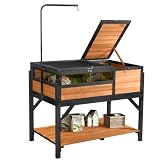
5. Aivituvin Habitat with Openable Roof – Best for Indoor Heating
Aivituvin Tortoise Habitat Turtle Enclosure, Wooden Tortoise House Reptile Cage for Small Animals, Reptile Tank with Large Storage Shelf
39.4 x 22.5 x 31.5 inch overall
29.5 lb wood build
Lamp holder 11 to 31 inch
Openable roof
Pros
- Lamp holder adjusts across a 20 inch vertical range
- Openable roof makes full cleaning simple
- 360 degree rotating lamp holder
- Weatherproof sleeping area
- Large storage shelf included
Cons
- Newer design with fewer long-term reports
- Heavier at 29.5 lb
- Roof is not insulated for outdoor winter use
This is the indoor heating pick. The lamp holder adjusts from 11 to 31 inches in height and 13 to 21.1 inches in width, and the roof opens on a 360 degree rotating mount, so you can position a UVB and heat fixture inside the enclosure at a real measured distance rather than hanging it off the side.
That range matters more than it looks. UVB output falls sharply with distance, and most indoor failures trace back to a bulb mounted too high because the enclosure had no rated mount. This one solves that problem in hardware.
The openable roof is the second win. Every other wooden unit in this roundup asks you to reach in through a front door for a full clean. Here you open the top, lift the tortoise out, and strip the substrate tray without dismantling the habitat.
It is a two-bedroom design at 39.4 x 22.5 x 31.5 inches, with a weatherproof sleeping area, an acrylic viewing window in the activity room, a moisture-proof finish for outdoor use, and a large storage shelf underneath.
Be aware of the age of the design. This one first appeared in December 2025, so the 322 reviews behind the 4.3 rating describe early adoption rather than years of outdoor weathering. Our terrarium controller guide covers the thermostat and probe setup you will want alongside it.
Lamp range and winter setup
For indoor winter housing of a Mediterranean species, this is the configuration we would build. Solid wood sides hold heat better than an open mesh pen, the lamp sits inside the enclosure at a distance you can measure, and the roof opens for daily checks without stressing the animal.
Pair it with a guard rail or curb liner if the tortoise is a digger. The base is designed to sit on a surface, not to be buried, and Horsfield’s keepers report 12 to 24 inch burial as the reliable fix for escape.
What the newer design lacks?
There is no long-term outdoor data yet, so anyone planning to leave it out permanently should plan on sealing checks each season. At 29.5 pounds it is one of the heavier wood units here and awkward to carry alone.
Check that the listing you buy shows the adjustable lamp holder and the openable roof, since similar-looking wood habitats often drop both, and confirm the panel dimensions match your available floor space before ordering.
6. PawHut Wooden Habitat – Budget Pick with Expandable Sides
PawHut Wooden Tortoise Habitat Indoor Tortoise House Enclosure Gray
35.75 x 23.75 x 12.5 inch overall
16.5 lb fir wood
Expandable side panels
Lockable latches
Pros
- Expandable side panels add floor space
- Lockable latches suit outdoor security
- Three large viewing windows
- Light at 16.5 lb
- On sale since 2021 with steady reviews
Cons
- Only 12.5 inches of wall height
- Wood can mold and the bottom can warp
- Side panels may not align
The PawHut D40-012 is the cheapest way into a real wooden habitat, and the expandable side panels are the feature that makes it more than a starter box. Pull the sides out and the living area grows, which lets you increase floor space without buying a second enclosure.
It has been available since April 2021, so unlike the newer designs here its review history includes years of use. The recurring feedback is consistent: good basic construction, easy assembly, and moisture problems if you leave it unsealed.
At 16.5 pounds it is the second-lightest unit in the roundup and the easiest to reposition. The lockable latches are also a genuine outdoor feature, since they keep a lid closed against wind and curious animals in a way most wooden habitats cannot.
Three large viewing windows mean you can observe the whole floor from most angles, which helps with the early morning check that a hide box otherwise hides from you.
The number to note before buying is the height. At 35.75 x 23.75 x 12.5 inches, the walls are 12.5 inches, and long-term reviews mention mold in humid setups, bottom warping over time, and wood splitting during screw installation.
When the low profile works?
A shallow profile is fine for box turtles and for juvenile Mediterranean species in a dry indoor room. It is also easier to heat than a tall unit, because less air volume means the lamp warms the space faster and runs less.
The expandable sides help here. Start with the base footprint for a juvenile, then pull the panels out as the animal grows, which delays the point where you need to move to a full-size pen.
Wall height and moisture problems
Twelve and a half inches will not stop a determined adult tortoise. For a Russian or Hermann’s that is fine in the short term, but it is close to useless for Horsfield’s, sulcata, or leopard, all of which climb or dig with real determination.
Seal the wood before humid use, and expect to inspect the bottom tray yearly. Owners also report that the side panels do not always align perfectly and that hideout doors may not close smoothly, so allow time for adjustments during assembly.
7. Magazoopet Large Enclosure – Best for Hatchlings and Diggers
Large Tortoise Enclosure with Lamp Stand, Wooden & Plastic Turtle Habitat
40.3 x 22.8 x 34.2 inch overall
27.6 lb fir and plastic
Lamp holder 5 levels
Slide-out tray
Pros
- Lamp holder adjusts on five horizontal and five height levels
- Dual-zone layout with separate lounging area
- Slide-out tray simplifies cleaning
- Clear acrylic viewing window
- Suited to hatchling quarantine
Cons
- Some reviewers question the sturdiness
- Instructions are vague and picture based
- Wood cracking reported on some units
The Magazoopet MY-TOR05 is the tallest unit in the roundup at 34.2 inches, and that height is the reason it earns the hatchling and digger badge. A deep hide built into the enclosure is what keeps a young tortoise from spending all day in the open, and a higher wall gives you more vertical room to build one.
The lamp holder is the most adjustable we found. It moves on five horizontal levels between 14.6 and 22.4 inches and across a height range of 30.5 to 38.4 inches, which lets you dial in UVB distance for an animal that is still growing quickly.
The dual-zone design splits lounging and activity areas, and the clear acrylic viewing window gives you an unobstructed view of the whole floor. The slide-out tray keeps daily cleaning to a single pull.
It is built from fir wood and plastic with reinforced edges, and the product data notes that lights are not included. There is also a second size variant at 39 x 22.8 x 33 inches if you want to check clearance in a smaller room.
Treat this one carefully at the start. Owners report a strong wood smell that needs airing out, vague picture-based instructions, and some units arriving with wood cracking or pieces that are not perfectly flush. Inspect it before you introduce an animal.
Hatchling fit and adjustability
For a hatchling in the first year, the tall profile and adjustable lamp range are exactly right. A UVB bulb that sits at a measured distance for a 4 inch animal will be too far away six months later, and this is one of the few units here you can re-aim as that changes.
The lounging area also gives a young tortoise a dry raised zone away from a damp substrate, which reduces the shell and respiratory problems that come with a permanently wet floor. Add a plastic liner to the slide-out tray until the wood is sealed.
Build quality to check on arrival
Several reviewers question how sturdy the unit is, and there are reports of wood cracking and pieces that do not sit flush. The 27.6 pound weight also makes it awkward to move once it is full of substrate.
Because it is a recent design, there is very little long-term data. Seal any exposed wood, check every screw joint in the first week, and keep it indoors or on a covered patio rather than as a permanent unsheltered outdoor pen.
8. ZENTAVO 3-Room Habitat with Balcony – Best Use of Vertical Space
3-Room Large Tortoise Habitat with Pull-Out Tray, Wooden Tortoise Enclosure Indoor & Outdoor with Ramp, Grass Mat, Openable Roof, Luxurious Reptile Enclosure for Small Animals, Yellow
44 x 25.6 x 24 inch overall
32 lb fir wood
Dual-level balcony layout
Openable roof
Pros
- Three-room layout with an upper balcony
- Mesh balcony adds light and ventilation
- Openable roof for direct access
- Includes ramp and grass mat
- Water-resistant outdoor paint
Cons
- Only available in one color
- Heaviest wood unit here at 32 lb
- Smaller review base than the rest
The ZENTAVO ZTV-0001YE answers a question most enclosures in this roundup ignore, which is what to do with vertical space. At 44 x 25.6 x 24 inches it uses a dual-level layout, with a sleeping area and balcony on the upper level and an expansive activity floor below, and a 44 x 25.6 inch footprint that comes close to 8 square feet on the lower level alone.
The metal mesh on the balcony handles two jobs at once. It lets sunlight through to the lower level, which helps with basking, and it ventilates the upper level so humidity does not build up under the roof.
The openable roof is genuinely useful here. With a ramp already included in the box, you can get a tortoise up to the balcony for care without dismantling anything, and the included grass mat gives the lower level a soft surface out of the box.
The pull-out plastic tray keeps cleaning simple, and the pre-drilled holes make assembly easier than the picture-only instructions on some competitors. The water-resistant outdoor paint is a step up from raw wood, though it is paint rather than a waterproof membrane.
Be honest about the evidence. This one has 94 reviews and a 4.3 rating, and it only arrived in October 2024, so you are buying a newer design with a smaller installed base than anything else in this roundup.
When a balcony layout helps?
Vertical space works well when floor area is limited, which is the situation in most apartments. Two usable levels inside a 44 inch footprint beats one level of the same size in a unit twice as long.
It also suits enclosure design that mirrors what a tortoise actually uses, which is a low sheltered area plus a raised dry area. The ramp and balcony are extras that make the space function, not just add surface area.
Color and weight limits
It is only offered in yellow, so it will not blend into a neutral room, and at 32 pounds it is the heaviest wood unit here. Two people should carry it, or move it empty before adding substrate.
The lower best-seller rank in the group also shows in the thinner review base. Check the screw joints and the ramp fit during the first week, and seal the wood if you intend to leave it outdoors through wet seasons.
Minimum Enclosure Size by Species
The most repeated number in tortoise forums is also the number most roundups leave out. The minimum floor area for an adult tortoise of the smallest commonly kept species is 8×4 feet, and larger species need proportionally more. Wall height matters too, and 12 inches is the practical floor.
Russian tortoise: adult shell length 8 to 10 inches. Minimum floor 8×4 feet, minimum wall height 12 inches. This is the baseline case for all sizing advice.
Hermann’s tortoise: adult shell length 7 to 9 inches. Minimum floor 8×4 feet, minimum wall height 12 inches.
Greek tortoise: adult shell length 8 to 11 inches. Minimum floor 8×4 feet, minimum wall height 15 inches for adults that climb.
Horsfield’s tortoise: adult shell length 6 to 8 inches. Minimum floor 8×4 feet, but dig-out containment is essential at 12 to 24 inches of buried base.
Red-footed tortoise: adult shell length 11 to 14 inches. Minimum floor 8×4 feet with 4x2x2 as the practical indoor layout, minimum wall height 24 inches.
Sulcata tortoise: adult shell length 14 to 20 inches. Minimum floor 8×4 feet and larger, minimum wall height 24 inches, and burial or curb liners are effectively required.
Lepard tortoise: adult shell length 14 to 20 inches. Minimum floor 8×4 feet and larger, minimum wall height 24 inches, heavy digger that needs reinforced bases.
Two corrections to widely repeated bad advice. One roundup in the top results recommends a 38x24x13 inch habitat for Russian tortoises, which is about 5.4 square feet and well under the minimum. Another suggests sizing height at 12 inches above the tortoise standing on its hind legs, which has no basis in husbandry and produces pens far too short. A second caveat on the low-walled units here: 12.5 inches of wall, as on our budget pick, is the bare minimum and not a comfort zone.
Indoor vs Outdoor: Which Enclosure Type You Actually Need?
Most roundups mix indoor and outdoor picks in one list, which leaves you unable to choose. Split them and the decision gets simple. Indoor housing is a heating and lighting problem. Outdoor housing is a containment and predator problem.
For indoor, choose a solid-sided unit that holds heat and has a rated lamp mount inside the enclosure. Open-top wood pens lose heat fast, and the common forum complaint about them is that they are close to impossible to heat properly, which pushes owners into running harder lamps for longer. A closed-top or solid-composite design solves the problem at the hardware level. The large composite unit in this roundup and the PVC unit are the two that handle winter housing best.
For outdoor, choose based on containment. A predator-hardened pen needs base panels buried 12 to 24 inches, or a curb liner, because dig-outs are the leading escape cause. Add a lock, hardware cloth around any gaps, and shade over part of the pen for hot climates. Wire mesh buried horizontally a foot out from the base is the standard buried barrier, and shade cloth at roughly 50 percent density is what makes a summer pen survivable.
Leave an enclosure outside year-round only if your climate and your setup both allow it. A tortoise can handle a wide temperature range, but constant wet, constant cold, and no way to get dry are what cause problems. Bring the animal in before sustained freezing unless you are specifically maintaining it for brumation, and move it in before autumn storms start.
Tortoise Enclosure Buying Guide: 9 Criteria That Matter
1. Floor area, not overall size. A tall narrow pen can look enormous on a product page while offering almost no walking space. Multiply interior length by interior width. Anything under 32 square feet is a temporary setup, not an adult habitat.
2. Wall height and dig-out resistance. Height alone is not containment. A tortoise that climbs or digs needs 24 inches of wall, 12 to 24 inches of buried base, or a curb liner. The three-room and balcony designs here help with climbing but not with digging.
3. Heat retention. Solid wood, composite, and PVC sides hold heat. Wire or mesh tops bleed it. This is the single biggest reason indoor pens fail, and the reason we ranked the units with solid sides and internal lamp mounts higher.
4. UVB mounting. A T5 HO UVB lamp is the standard for tortoises. Mount it inside the enclosure, above the animal, not outside above a screen top, because mesh and acrylic viewing panels filter out a meaningful share of UVB. Keep the lamp roughly 12 to 18 inches above the tortoise for a T5 HO, adjust for the fixture, and never let the tortoise walk under a lamp hot enough to burn.
5. Photoperiod. Run UVB and heat on a timer for 10 to 12 hours in summer and 8 to 10 in winter, matching natural day length. Turn basking heat off at night and let the enclosure drop to a night floor around 60F or above. Continuous basking light removes the day-night cycle that regulates tortoise activity.
6. Basking and cool-side targets. Aim for a basking zone of 90 to 100F measured with a thermometer at the surface, and a cool side of 70 to 80F. A thermostat or dimming controller keeps the heat lamp from overshooting, which matters most in the closed composite units where heat builds quickly. Our terrarium controller guide covers the options.
7. Substrate depth and tray access. A removable tray you can pull out in thirty seconds changes how often you deep clean. For diggers, provide 4 to 8 inches of soil-based substrate deep enough to bury into. Avoid gravel, walnut shells, and reptile carpet, none of which hold moisture or allow natural burrowing behavior.
8. Weatherproofing and outdoor hardening. Wood enclosures need sealing before outdoor use, and the model data here shows which ones are water resistant by design and which are not. Check the base is solid all the way around, that latches are metal, and that any mesh is buried rather than lying on the surface.
9. Expandability and cleanability. A unit with pull-out side panels or a top that opens will outlast a sealed box. Buying the larger unit once is cheaper than replacing a starter pen every eighteen months, which is the normal cycle for undersized store enclosures.
On cleaning frequency, spot clean daily, do a full substrate change every two to four weeks, and wash the tray with hot soapy water and dry it fully before refilling. Deep water soaking of a wooden enclosure accelerates the mold and warping that owners already report in long-term reviews.
Frequently Asked Questions
How big should an enclosure be for a tortoise?
The minimum is 8×4 feet of floor area for an adult tortoise of the smallest commonly kept species, such as a Russian or Hermann’s. Larger species including sulcata, leopard, and red-footed tortoises need proportionally more floor space. Measure interior length by interior width rather than relying on the overall product dimensions, and treat anything under 32 square feet as a temporary setup. Wall height is a separate rule: 12 inches is a bare minimum and 24 inches is better for species that climb or dig.
What type of enclosure is best for a tortoise?
A solid-floored wooden, composite, or PVC pen with 8×4 feet of floor area, a shaded hide, a basking zone, and a removable substrate tray. Indoors the priority is heat retention and a lamp mount that holds a T5 HO UVB lamp above the animal. Outdoors the priority is containment: buried base panels or a curb liner, shade, and predator-resistant hardware. Do not buy a filtered glass tank or an aquatic turtle kit, which are made for swimming species and are the most common wrong purchase in this space.
What is the best indoor enclosure for a tortoise?
The best indoor enclosure is a solid-sided composite or PVC unit with locking glass doors and a lamp mount inside the top. Solid sides retain heat far better than open-top wooden pens, which is the most common indoor complaint in tortoise forums. The large composite unit in this roundup and the 4x2x2 PVC unit both hold temperature well and clear the adult size minimum. Mount UVB and heat lamps inside the enclosure rather than above a screen top, since mesh filters out part of the UVB output.
What is the best outdoor enclosure for a tortoise?
The best outdoor enclosure is a pen with base panels buried 12 to 24 inches or fitted with a curb liner, hardware cloth on all gaps, a secure lock, and shade covering part of the area in hot months. A raised garden bed with a greenhouse or cold frame on top is the most common owner-built solution, typically at 4×8 feet. Bury wire mesh horizontally about a foot out from the base to stop dig-outs, and add 50 percent shade cloth to keep summer temperatures survivable.
How much UVB light does a tortoise need, and how far should the bulb be?
Tortoises need a T5 HO UVB lamp providing 10 to 12 percent UVB output, and the output falls sharply with distance. Mount the lamp inside the enclosure above the animal, generally 12 to 18 inches from the tortoise for a T5 HO fixture, and never above a screen top or behind an acrylic viewing panel. Run it on a timer for 10 to 12 hours in summer and 8 to 10 in winter, and replace the lamp on schedule rather than waiting for it to visibly fail.
How hot should a heat lamp be for a tortoise, and should it stay on at night?
Aim for a basking surface of 90 to 100F measured with a thermometer, with a cool side of 70 to 80F so the animal can move between zones. Turn the basking lamp off at night and let the enclosure fall to a night floor around 60F or slightly above. Leaving basking light on continuously removes the day-night cycle tortoises rely on for activity and feeding, and in a closed-top enclosure it also raises the risk of overheating.
What is the most common cause of tortoise death?
The most common preventable causes are related to setup rather than disease. An enclosure that is too small or too low causes crowding and stress, inadequate UVB produces soft shells, shell pyramiding, and metabolic bone disease, and failed temperature gradients cause respiratory illness. Drowning in an aquatic turtle tank and heatstroke from an overheating enclosed pen are both frequent and entirely preventable. Habitat size and correct heat and UV delivery decide most of these outcomes before any product is chosen.
How often should I clean a tortoise enclosure?
Spot clean every day by removing waste and replacing soiled substrate. Do a full substrate change every two to four weeks, or sooner if the enclosure smells or stays damp. Wash a pull-out tray with hot soapy water and dry it completely before refilling. For wooden habitats, avoid soaking the whole unit, since long-term owners report mold and warped bottoms on unsealed wood. For high humidity hatchling setups, expect to change substrate more often than the standard interval.
Bottom Line: The Best Reptile Enclosure for Tortoises
Our editor’s choice is the Aivituvin Wooden Tortoise House, and the reason is evidence rather than features. With 2200 reviews and the longest design history in the group, it is the only unit here where we can judge how the weatherproof bottom and solid wood hold up over years instead of months. It is also the cheapest way to solve the small-setup problem properly, and it pairs well with an outdoor pen once the animal outgrows it.
For an adult tortoise, the honest recommendation is bigger than anything on a shelf at the moment. The 4x2x2 PVC unit meets the 8×4 foot minimum and has the highest rating we found, and the large composite unit is the only single unit that clears it with room to spare. For indoor winter heating, choose solid sides and a lamp mount inside the enclosure. For outdoor, bury the base or add a curb liner before you worry about anything else.
Whichever you pick in 2026, remember that the enclosure is only one part of the setup. Add a T5 HO UVB lamp, a heat lamp with a controller, and a deep enough substrate tray, and check both temperature zones with a thermometer before you trust either number.