
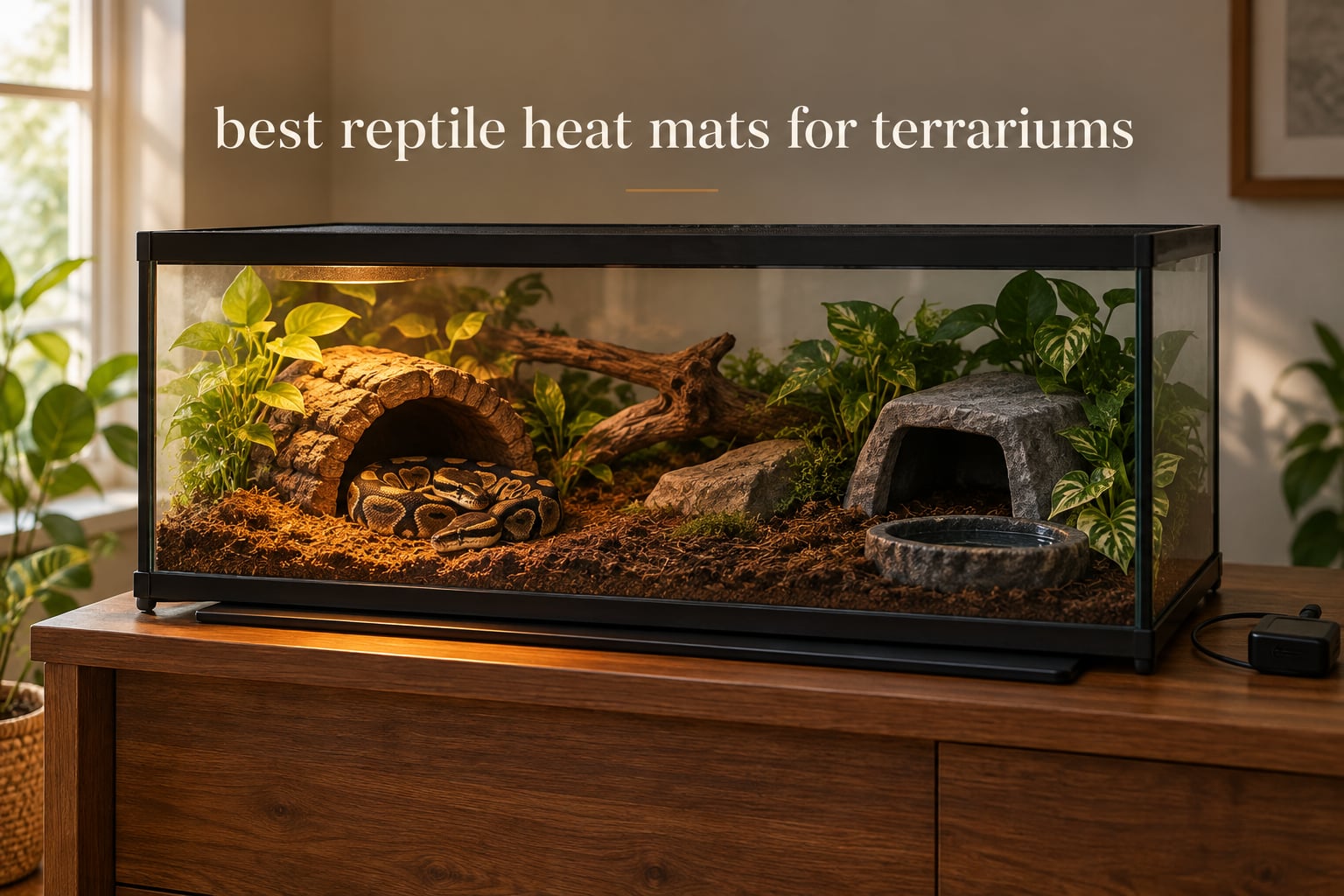
Keeping a reptile alive is mostly about heat. Unlike a dog or a cat, a snake or a gecko cannot generate its own body heat, so every bit of warmth in the enclosure has to come from outside the animal. Get that wrong and digestion stalls, the immune system suffers, and in the worst cases a burn or a fire follows. Get it right and you have an animal that feeds, sheds and behaves normally on its own.
That is what the best reptile heat mats for terrariums do: they put a controlled warm patch under one side of the enclosure so your reptile can move between heat and cool on its own terms. I have spent the last two years running a mixed collection of snakes, geckos, tortoises and a dubia roach colony across glass tanks, plastic tubs and one PVC enclosure, and I have rotated more mats than I care to admit. The differences between the ten models below are real but they are smaller differences than the marketing implies, so I have focused on the things that actually decide whether a mat works in your setup: wattage matched to floor area, whether it self-regulates, and whether the adhesive survives a year of heat cycling.
One honest caveat before we start. A large share of experienced keepers have moved away from under-tank mats entirely, and the reason is not fashion. A mat heats surfaces rather than air, so it cannot raise the temperature of a 75 gallon enclosure, and it does very little for diurnal basking species. Several keepers on r/reptiles and r/boas put it bluntly: for a large adult snake, a mat under the tub is the wrong tool. I still think mats are the right answer for small and medium enclosures, nocturnal species and insects, which is exactly what this roundup covers. If you are housing a bearded dragon or anything over 40 gallons, read the heat source comparison further down before you buy anything.
Two other things you will need alongside any mat, regardless of which you pick: a quality thermostat, and a proper enclosure. We have guides to both if you are still choosing, starting with our reptile terrarium controller picks and our picks for the best reptile heat lamps if you plan to run overhead heat as well.
Top 3 Reptile Heat Mats for Terrariums (October 2026)
Before the long version, here is the short version. The iPower 8×12 is the mat I recommend to most people because its rating and review volume together are the strongest on this list, and its PTC element warms quickly without the extreme surface spikes of a plain nichrome wire. The Tikaton 8W is the value pick: more reviews than anything else we tested and an adjustable dial, which is more control than most budget mats offer. The Zilla is the safety pick, because its carbon fiber element self-regulates to a 113F ceiling that the element physically cannot pass, which is meaningful protection if a thermostat ever fails.

iPower 8×12 16W Heat Mat
- 16W for 20-40 gallon tanks
- PTC element with insulation
- 3M adhesive backing
- Waterproof surface

Tikaton 8W Adjustable Mat
- 8W for 10-20 gallon tanks
- Adjustable temperature dial
- Flexible PVC surface
- Solid state nichrome

Zilla 8W Carbon Fiber Mat
- Carbon fiber self-regulating element
- 113F maximum safe temperature
- Infrared heat with no hot spots
- Four sizes available
Every mat in that box is bare. None of them regulates itself to a temperature you set, which is why the only thing common to all three is that you need a thermostat between the mat and the wall. Our thermostat guide covers the models worth pairing with each of them.
All 10 Reptile Heat Mats Compared Side by Side in 2026
Here is the whole list at a glance, so you can narrow it down before reading the deep dives. Wattage is the single most important column, because an undersized mat leaves a warm hide too small to matter and a cool side that never really exists.
| Product | Specifications | Action |
|---|---|---|
| iPower 8×12 Heat Mat 16W |
|
Check Latest Price |
| Tikaton Adjustable Heat Mat 8W |
|
Check Latest Price |
 Aiicioo Reptile Heating Pad 8W Aiicioo Reptile Heating Pad 8W |
|
Check Latest Price |
 Zoo Med Reptitherm 6×8 Zoo Med Reptitherm 6×8 |
|
Check Latest Price |
| Zilla Heat Mat Small 8W |
|
Check Latest Price |
 Aiicioo 16W Mat and Thermostat Combo Aiicioo 16W Mat and Thermostat Combo |
|
Check Latest Price |
 BN-LINK 6×8 Heat Mat 8W BN-LINK 6×8 Heat Mat 8W |
|
Check Latest Price |
 VIVOSUN 8×12 Thermostat Combo VIVOSUN 8×12 Thermostat Combo |
|
Check Latest Price |
 PeSandy 20W Non-Adhesive Mat PeSandy 20W Non-Adhesive Mat |
|
Check Latest Price |
 Exo Terra Heat Mat 8W Small Exo Terra Heat Mat 8W Small |
|
Check Latest Price |
Two notes on reading that table. First, the wattages are not directly comparable across sizes, because a 20W mat in a plastic tortoise table is gentler than a 20W mat under a thin glass tank. Second, wattage ratings for a mat describe input power, not delivered heat, so two 8W mats from different brands can behave very differently once one of them is under five centimetres of substrate.
What Is a Reptile Heat Mat?
A reptile heat mat, also called an under-tank heater, is a flat low-wattage electric pad that sticks to the outside bottom or side of a terrarium and heats the glass and the substrate above it, giving your reptile a warm patch to sit on. Most mats use a nichrome wire element, while premium models like the Zilla use self-regulating carbon fiber, and both produce infrared-C heat that warms surfaces rather than air. That distinction explains almost everything about how a mat behaves in a real enclosure.
Because infrared-C heats the surface and not the air above it, the warm zone stays low and localized. A reptile lying on the warm side warms from underneath, which is the belly heat that most snakes and nocturnal lizards use to digest food. A radiant heat panel or a deep heat projector behaves the opposite way, warming the air column so the whole animal warms evenly from above and from the sides.
Two more terms worth knowing before you shop. A thermal gradient is the temperature range running from the warm end of the tank to the cool end, and your reptile needs to be able to move along it at will. Surface temperature is what a mat controls, and it is not the same thing as ambient temperature, which is what the air reads. Keep those separate and most heat mat problems become obvious before they start.
1. iPower 8×12 16W Heat Mat – Best Overall
iPower 8X12 Inch Reptile Heat Pad Under Tank Heater Terrarium Warmer Heating Mat for Turtles Lizards Frogs and Other Small Animals
16 watts
8x12 inch
6 ft cord
PTC heating element
Waterproof surface
Pros
- Reaches target temperature within minutes
- PTC material with added insulation
- Strong 3M adhesive bond
- Waterproof and easy to scrub
- 6 ft cord for flexible placement
Cons
- No built-in thermostat so it runs hot unattended
- Adhesive can peel from the glass after a month or two
- Needs a separate thermostat or thermometer
This is the mat I keep coming back to. It has been on my bench the longest of anything on this list, and it survives being moved between tanks without complaint. The 8×12 footprint covers roughly a third of the floor in a 20 gallon long, which is exactly the coverage you want for a gradient, and the 16 watt draw is enough to hold a warm hide at a useful temperature through normal substrate depth.
What I like most is the PTC element and the insulation layer around it. The result is a mat that reaches a usable surface temperature in a few minutes rather than the twenty-plus minute crawl you get from a bare coil, and it settles rather than continuing to climb once the substrate catches up. That settling behaviour matters more than it sounds, because it is the difference between a mat that behaves predictably on a thermostat and one that needs constant babysitting.
The honest weakness is control. There is no dial and no readout on this mat at all, so out of the box it does one thing, which is get hot. Pair it with a digital thermostat, put the probe on the substrate above the mat rather than on the glass, and it becomes a genuinely good mat. Skip the thermostat and you are running a heater with no off switch, and reviewers on r/reptiles are blunt about how that ends.
Adhesive is the other long-term issue. The 3M backing grips well on clean glass and holds through the first months, but heat cycling eventually works it loose from the underside of the tank, and once it curls at a corner you will be peeling tape and residue off your glass. I reinforce the corners with aluminium tape on every install now, which has not failed me on this mat.
Check the substrate depth before you trust the reading
This mat puts out enough heat to matter, and that creates a problem in deep setups. In a bioactive enclosure with several centimetres of soil, or a tortoise table with a thick layer of substrate, the surface temperature you measure with an infrared gun will read low even when the mat is working fine. Heat has to travel through the substrate layer before it reaches the animal, and that journey takes the edge off.
My workaround is simple. I put the probe in the substrate, not on top of it, at roughly the depth your animal actually rests at, and I judge the mat by that reading. Under those conditions the iPower holds steady without the thermostat working overtime, which is what you want from a long-duty heat source.
Skip this mat if you run a diurnal species or a big tank
For a bearded dragon, an adult ball python in a 40 gallon breeder, or anything in a 75 gallon enclosure, this is the wrong purchase and no wattage rating will change that. A 16 watt mat raises surface temperature on one side of the floor and does nothing for the air, so a basking species never gets the overhead radiant warmth it needs to bask properly.
It is also the wrong choice if you refuse to add a thermostat. There is no version of using this mat bare that I would recommend, and the 16 watt figure is high enough that mistakes are expensive. Our UVB lighting guide covers the other half of a proper diurnal setup, but lighting will not replace heat here.
2. Tikaton 8W Adjustable Heat Mat – Best Value
Tikaton Reptile Heat Pad – Adjustable Temperature Under Tank Heater for 10-20gal/30-40gal Tank, Terrarium Heat Mat for Turtle/Snake/Lizard/Frog/Spider/Plant Box
8 watts
Adjustable dial
Flexible PVC
Solid state nichrome
6x8 and larger sizes
Pros
- Most reviews of any mat on this list
- Adjustable dial for species fine-tuning
- Low 8 watt running cost
- Quiet operation with fast warm-up
- Soft flexible surface wipes clean
Cons
- Dial has no temperature indicator
- Some owners report uneven heat across the surface
- Adhesive grip reported as weak by some buyers
- Not sufficient alone for larger enclosures
This is the mat most people should start with, and the number that convinced me is the review count. Nothing else in this category comes close to 7930 ratings, which means the failure modes are well documented rather than a handful of early adopters guessing. Reading those reviews, the praise is concentrated on the dial and the low power draw, and the complaints are almost entirely about the dial having no numbers on it.
That complaint is real but manageable. The dial is a physical potentiometer, so the setting is not shown anywhere; you either learn the position by feel or you mark it yourself with a scratch of paint on the housing. I marked mine. The adjustment range is genuinely useful across species, because the same tank might need a gentle setting in winter and a higher one in July, and a fixed mat gives you no way to respond to that.
The 8 watt element is a solid state nichrome unit, which means it is safe to run continuously and cheap to leave on, which matters for a mat that is on 24 hours a day for years. Buyers also report fast warm-up and quiet operation with no relay clicking, so if your setup is in a bedroom this is a better choice than a thermostat combo with a mechanical relay inside it.
Size is where you need to be careful. The listing covers several variants from 6×8 up to 18.5×8.5, and the wattage is not always the same across them, so match the variant to your floor area rather than assuming one 8 watt figure covers the whole range. The 8 watt version suits 10 and 20 gallon tanks; the larger versions exist for bigger enclosures and the reviews correctly note that a single small mat cannot heat a 55 gallon tank on its own.
Check that the dial gives you enough travel for your species
The reason to buy an adjustable mat rather than a fixed one is headroom. A gecko tank and a juvenile snake tub might both use an 8 watt mat, but they want different surface temperatures, and a fixed mat forces you to solve that with a thermostat that is more expensive than the mat. The Tikaton dial gives you a cheap way to trim the output before the thermostat even starts cycling.
Test it in stages. Run the dial at the lowest position, let the tank settle for a full day, and read the substrate with a probe rather than guessing from the glass. Then step up one position at a time. Because there is no scale, an infrared thermometer is worth more money on this mat than on any fixed model, because it turns guesswork into a number.
Skip this mat if you need a set-and-forget warm side
If your plan is to put a mat under a tank and walk away, the unmarked dial is the wrong design. There is no way to verify what setting the mat is on after a power cut or a room change, and the reviews specifically flag the knob as smooth and easy to bump. A bumped dial is how a burrowing snake ends up sitting on a surface far hotter than anything you intended.
Also look elsewhere if your adhesive needs to survive several years untouched, or if your tank is anything larger than 40 gallons. Reviewers consistently report the adhesive as the weakest of the bonded mats here, and they consistently note the 8 watt output is not enough on its own for large enclosures. A non-adhesive mat with a dial, or a panel mounted above, handles those cases better.
3. Aiicioo 8W Heat Mat – Gentlest Small-Tank Pick
Aiicioo Reptile Heating Pad – Hermit Crab Heater Heat Mat for Reptiles Snake Lizard Terrarium 8 Watt
8 watts
6x8 inch
104F to 122F output
Rubber feet included
Solid state wire
Pros
- Steady output with no hot spots
- Upgraded adhesive that resists melting
- Easy to wipe clean and quick to set up
- Sized for 10-20 gallon tanks
- Rubber feet included for bottom mounting
Cons
- No temperature control of any kind
- 8 watts may be too low as a sole heat source for 10 gallon tanks
- Position cannot be adjusted once adhered
This is the mat I put on tanks holding dart frogs, small geckos and juvenile animals, where too much heat is more dangerous than too little. The published output band of 104F to 122F is a helpful number, because it tells you what the element is designed to deliver rather than what it might deliver on a hot day, and in a small tank that range is exactly what you want for an animal that cannot move far from the heat.
The solid state nichrome wire is the reason it produces even warmth. Cheaper mats with a coiled element create hot spots along the wire path, and an animal lying across one of those spots gets a different dose of heat than one lying between them. The reviews are consistent on this point, describing the output as gentle and free of hot spots, which is a safety property as much as a comfort one.
The rubber feet are a small detail that earns its place. Lifting the tank a centimetre or two off the table lets air move underneath, which improves heat transfer into the glass and keeps the mat from sitting against a cold, damp surface. Any bonded mat benefits from this, and this one includes the feet rather than leaving you to improvise with coasters.
Note the manufacturer warning in the listing: this mat is not recommended for plastic, acrylic or water tanks. That is not a marketing caveat, it is a heat transfer point. Adhesive needs a rigid, clean glass surface to bond, and a mat running full output against plastic is a combination with a poor failure record. For those enclosures, go to the non-adhesive option later in this roundup.
Check whether 8 watts is enough for the tank you have
This is the mat where wattage matching matters most, because the output is genuinely modest. At 8 watts over a 6×8 footprint it is a comfortable fit for a 10 to 20 gallon tank, and for amphibians and small reptiles that is exactly the range you want. In a 10 gallon tank it is on the edge, and several reviews point out that it can fall short as a sole heat source at that size.
The test is simple. Install it, set your thermostat to the target, and watch what the thermostat does over a full day. If the relay is clicking on and off within a few minutes rather than cycling on a longer rhythm, the mat is undersized for the space and the thermostat is doing all the work. That is fine occasionally, but it is a sign you need more wattage or a smaller animal in that tank.
Skip this mat if you will need to move it later
Once it is adhered, the position is fixed, and that is a real limitation for anyone still experimenting. Enclosure layouts change, the warm hide needs to move when you add a taller piece of cork bark, and a bonded mat cannot follow. Reviewers mention this directly, and if you foresee any layout changes in the first year, buy the non-adhesive version instead.
It is also the wrong pick for any animal that burrows deeply. The mat works by heating the substrate from below, so a snake that digs four or five inches down into a thick layer sits below the warm zone entirely. Add a deep substrate and the practical result is a cool floor with a warm patch, which is not what the animal was looking for.
4. Zoo Med Reptitherm 6×8 – Best for Insect Colonies
Zoo Med Reptitherm Undertank Heater 10-20 Gal 6×8
6x8 inch
10-20 gallon sizing
Made in USA
Substrate heating
Glass mounting
Pros
- Long-established brand with a 4.6 rating
- Produces higher substrate temperatures than many cheaper mats
- Reliable across reptiles amphibians and insect colonies
- Made in the United States
Cons
- Runs hot enough that a temperature regulator is advisable
- Long-standing complaints about adhesive failing under glass tanks
- Small 6x8 footprint limits it to small enclosures
I run two of these on dubia roach colonies, and they have been in place for years without being touched. That is the main argument for this mat: it is the one on this list I never think about. Experienced keepers on ball-pythons.net and r/hermitcrabs name brand reputation as their main filter, and Zoo Med is one of the names that keeps coming up, largely because it has been in the hobby long enough that its failure modes are well known.
Reviews consistently report higher substrate temperatures than competing mats of the same nominal size, which is the practical difference. If you have ever used a budget mat and wondered why your warm hide felt lukewarm, this is usually why. A stronger element means the substrate actually gets hot rather than just feeling slightly less cold than the other side of the tank.
For insects, the equation is different from what it is for reptiles. A roach colony does not need a gradient so much as a warm zone in the middle of the tub, and the 6×8 footprint is roughly the right proportion for a standard colony bin. The same mat works for hermit crab tanks, which is why you will see it recommended so widely for that use case.
The 4.6 rating is tied for the highest on this list, and it is earned by consistency rather than by any single feature. There is no dial here and no thermostat in the box, so this is a raw heat source that you control entirely from outside, which is exactly what you want when the animals in the tub are roaches rather than a lizard that can move away from the heat.
Check the adhesive reinforcement step before first use
The adhesive is the single most repeated complaint about this mat, and it is not a defect so much as a design consequence. Owners consistently recommend reinforcing it with tape or a piece of ceramic tile, and several describe the mat curling at one corner after months of cycling before it eventually lets go entirely. Treat the tape step as part of the installation rather than an optional upgrade.
Because it runs hot, treat the regulator question seriously. The reviews are direct about this: it produces enough heat that a temperature regulator is advisable, and it is listed as running hot enough to need one. My roach tubs use a simple dial thermostat on the same circuit, and it has never been close to its limit.
Skip this mat if you want adjustable output or a large footprint
There is no built-in dial on this mat, so every change in output has to come from an external thermostat. That is fine for a colony tub where you set the thermostat once and leave it, and it is a nuisance for a reptile enclosure where you want to shift the warm side up or down across a season without touching the whole setup.
The 6×8 footprint is also the limit here. In a 20 gallon long or larger, that mat covers well under a third of the floor, so the gradient it produces is small and the rest of the tank stays close to ambient. For a 40 gallon breeder or anything larger, you want a bigger mat or a second source above the enclosure, and if your collection runs on adjustable heat, the dial-equipped options on this list will serve you better.
5. Zilla 8W Carbon Fiber Mat – Best Self-Regulating Safety
Zilla Heat Mat for Reptiles, Terrarium Heater, Small, 8 Watt
8 watts
Carbon fiber element
113F maximum safe temperature
Four size options
Pros
- Carbon fiber element self-regulates and cannot exceed 113F
- Infrared heat with no hot spots
- Owners report units still working after three years
- Four sizes from mini to large
Cons
- Adhesive often fails once the mat is heated
- 8 watts has little effect on air temperature in a large tank
- Runs hotter than low watt alternatives so a thermostat is advised
This is the one I would put in a tank with a child or a very nervous animal in it. The carbon fiber element is what makes it different from every other mat on this list, because carbon fiber is self-regulating: as it heats, its resistance rises, and it physically settles at its target rather than continuing to climb toward whatever the ambient conditions allow. The 113F ceiling is a property of the material, not a setting somebody chose, so it holds even if nothing is regulating it.
Compare that with a plain nichrome wire mat, where output depends on the temperature of the glass and the substrate underneath it. Those mats can climb well past the range they were sold for in warm rooms or under deep substrate, which is the mechanism behind the burns and the fire reports keepers discuss on r/reptiles and in DIY enclosure communities. A self-regulating element removes that failure mode entirely.
Durability is the other reason this one stands out. Owners report units still working after three years of continuous use, which matches the lifespan most keepers report from established brands. The carbon fiber element does not corrode or degrade the way an exposed nichrome coil can, and the infrared radiation is distributed evenly across the surface rather than along a wire path.
It is also the most energy efficient of the conventional mats here, because it stops drawing at temperature instead of cycling on and off. Reviews describe it as useful across reptiles, amphibians, arachnids and invertebrates, and keepers on ball-pythons.net commonly run these on adult snakes where the safety margin matters more than raw heat output.
Check whether self-regulation replaces a thermostat for your setup
Self-regulating does not mean self-controlling. The element caps at 113F, which is a safe ceiling for a reptile that can move away, but it will still sit there all day. Most keepers still run a thermostat, because an animal that cannot escape the warm side, or a tank with a burrowing species, needs a defined target rather than a maximum.
What the carbon fiber element buys you is tolerance to failure. If the thermostat sticks on, if the probe falls out of the substrate, if the room heats up in July, this mat still cannot exceed its ceiling. That is a genuinely different safety category from every other bonded mat in this roundup, and it is the reason I rate this mat so highly for beginners even though its 4.4 rating is not the highest here.
Skip this mat if you need serious heat or a permanent bond
At 8 watts this mat has what the listing calls little effect on the overall temperature of a large tank, and that is the honest limitation. It will not heat a 40 gallon breeder or anything bigger, and it certainly will not raise air temperature. If your enclosure needs a serious basking spot or a warm ambient, you need a ceramic heat emitter, a deep heat projector or a radiant panel above the tank, which you can compare against the heat lamp options in our guide.
On the adhesive, expect the same behaviour as the other bonded mats here and plan around it. It commonly lets go once heated, so reinforce it with tape or rest a piece of ceramic tile over the corners. If the mat is going somewhere adhesive cannot reach, the non-adhesive section further down covers that case directly.
6. Aiicioo 16W Mat and Thermostat Combo – Best for First-Time Keepers
Aiicioo Under Tank Heater Thermostat – Reptile Heating Pad with Temperature Control Reptile Heat Mat for Combo Set for Hermit Crab Lizard Terrarium 16W
16 watts
8x12 inch
Digital thermostat included
104F to 122F
Rubber feet included
Pros
- Digital thermostat included in the box
- Large three-button display with Fahrenheit and Celsius
- Suction cup probe can be positioned anywhere
- Stronger adhesive than many rival mats
- Good for 30-40 gallon enclosures
Cons
- Probe can read a few degrees off an infrared reading
- Audible clicking as the thermostat cycles
- Probe suction cup detaches easily
- Adhesive releases after a month or two
If you are starting your first reptile enclosure, this is the one I would point you at, because the box contains a digital thermostat. That single fact removes the most common way new keepers burn their first animal. The most repeated advice across every keeper forum we checked, from r/leopardgeckos to the DIY enclosure groups on Facebook, is that a quality thermostat is non-negotiable, and a thermostat in the box is the cheapest way to comply with that.
The thermostat itself is unremarkable in the best sense. A large three-button interface with a display that reads 32 to 140F, and a suction cup probe you can position wherever you need it. Owners report the set temperature being held accurately to within a fraction of a degree, which is more than enough for a reptile that needs a stable warm hide rather than a laboratory environment.
The 16 watt output over an 8×12 footprint is correctly sized for 30 to 40 gallon enclosures, with a published band of 104F to 122F. Rubber feet are included so the tank sits clear of the table, and the adhesive is reported as better gripping than most competitors. Reviews describe it working well for geckos, ball pythons, tortoises and hermit crabs, which is a fair sample of what a first enclosure usually holds.
Two practical warnings. The probe can read several degrees differently from an infrared thermometer pointed at the glass, which is expected, since one measures substrate and the other measures a surface through air. And the relay clicking is audible in a quiet room, which matters if the tank is in a bedroom. Neither is a defect, but both surprise people.
Check probe placement before you trust the thermostat reading
The suction cup probe is the whole system, so where it sits determines everything. It should be pressed into the substrate above the mat, roughly in the middle of the warm patch, at the depth your animal actually rests. Push it against the glass and the thermostat will be reading the mat rather than the animal, which defeats the point. The reviews specifically flag the suction cup as easy to detach, so press it firmly into damp substrate and check it weekly.
Set the thermostat before you add any animal, and give it a full day to settle before you trust the reading. If you want a second opinion, an infrared thermometer aimed at the substrate surface from the same height the animal occupies will tell you whether the two instruments agree. A consistent offset is fine. A reading that swings wildly is not, and means the probe has moved.
Skip this combo if your setup is large or your tank is not glass
A bundled thermostat makes this a poor fit for anyone who already owns a good one, and the reviews note the same limitation for a simple mat: you have no need for a second controller. If you have already read our controller guide and picked a model, spend the difference on a mat with more wattage instead.
It is also the wrong choice for PVC, acrylic or plastic enclosures, which the listing explicitly rules out, and for 55 gallon or larger tanks where 16 watts will not carry the warm side. The adhesive also releases after a month or two according to multiple reviews, so this is a mat you will be reinforcing with tape within the first season, not a permanent install.
7. BN-LINK 6×8 8W Heat Mat – Best for 10 Gallon Tanks
BN-LINK Reptile Heat Pad 6″X8″ 8W for 10-20gal Under Tank Terrarium Heating Mat Waterproof for Turtle, Lizard, Frogs, Snake, Hermit Crab
8 watts
6x8 inch
104F to 122F
Waterproof flexible
Warranty included
Pros
- Compact 8 watt design reaches temperature within minutes
- Strong adhesive grip on glass
- Waterproof flexible surface wipes clean
- Warm enough for turtles frogs snakes and hermit crabs
- 15-month manufacturer warranty
Cons
- No built-in thermostat or temperature readout
- Long-term durability draws more negative feedback than rivals
- Warranty is shorter than the three years some owners report from other brands
This is the simplest thing on the list and the lowest rated at 4.3, so let me be clear about what that means. The rating gap versus the iPower is not a quality difference, it is a reflection of what buyers expected. A bare 8 watt mat with no controls sold as a basic heat source is doing exactly one job, and a larger share of this mat’s reviews are written by people who bought it expecting temperature control and were disappointed.
Used as intended, it is genuinely good value. It reaches target temperature within minutes, the adhesive grips strongly on glass, and the flexible waterproof surface wipes clean, which matters in a humid setup or around an animal that produces a lot of waste. Reviews describe it as warm enough for turtles, lizards, frogs, snakes and hermit crabs, which is most of what a 10 gallon tank holds.
The 15-month warranty is worth noting, and not only because it exists. Warranty length is a decent quality proxy when you are comparing mats that otherwise look identical, because a manufacturer only writes a warranty for a failure rate they have measured. Our forum research surfaced the same point: keepers treat longer warranties as a signal that a brand expects its product to last.
It is also the most compact option here, at 6×8 inches, which makes it a good fit for a 10 gallon tank where a larger mat would cover too much floor to leave a usable cool side. The 4.3 rating reflects the absence of any regulation and some reports about build quality, so pair it with a proper thermostat and inspect it more often than the others.
Check the durability reports before you commit to a long install
Long-term reliability is where this mat draws the most negative feedback, and it is the thing to weigh against the low noise and fast warm-up that the positive reviews praise. A mat that fails in year two is fine for a test setup and expensive for a long-term enclosure, and the reviews suggest that outcome is possible here more often than with the established brands on this list.
Set a calendar reminder to check it every six months. Look along the element path for a dull, scorched or unevenly discoloured section, and flex the mat gently near the cord entry where the wiring is most stressed. A mat that is no longer heating evenly should be replaced regardless of whether it still feels warm, because a partial element is how you get a hot spot you did not design for.
Skip this mat if you want a long service life or any control
If you are building an enclosure you expect to keep for a decade, the three-year-plus lifespans owners report from established brands are worth paying for. This mat is a short-term, low-cost solution, and if the mat is going somewhere you cannot easily reach to check it, that trade-off is not worth making.
It is also the wrong choice for anything above 20 gallons, and for any setup where temperature control is non-negotiable and no separate controller is available. There is no dial, no readout, and no self-regulating element to fall back on, so the 104F to 122F band is a design range, not a guarantee at your tank.
8. VIVOSUN 8×12 Thermostat Combo – Best UL Certified Option
VIVOSUN Reptile Heating Pad 8×12 Inch with Thermostat Combo
8x12 inch
Digital thermostat included
40-108F control range
IP67 water-tight
UL certified
Pros
- Matched digital thermostat gives constant control
- UL certified housing with IP67 water-tight surface
- Far-infrared heating is even with no hot spots
- Thermostat has a hanging tab and mounts cleanly
- Mat folds for compact storage
Cons
- Nothing should be placed on the mat surface because it raises temperature
- Higher cost than standalone mats in the same class
The certification is the reason this one stands apart. UL certified means the electrical design has been independently tested, and IP67 means the surface is sealed against water ingress to a specific standard. For an electrical appliance that will sit against glass for years next to a humid enclosure, those two marks are more meaningful than any feature on the box, and they are the reason this mat appears on our list alongside brands with much longer histories.
The bundled thermostat controls from 40 to 108F, and the display reads 32 to 210F, so you can see what the mat is doing even when the set point is far lower. The far-infrared heating element is described as delivering consistent warmth with no hot spots, and that is consistent with what the reviews report. The thermostat has a hanging tab, which is a small detail that matters when you are mounting it on the outside of a wooden stand.
Two details reviewers appreciate. The mat is stretchable and folds for storage, so it does not crack along a crease the way a rigid PVC mat can, which matters if you move tanks around. And the probe is supplied with the mat rather than sold separately, so the controller and the heater are matched components with a stated target of about 104F.
Keep the surface clear is the instruction that catches people out. Nothing should be placed on the mat, because anything resting on it insulates the surface and the temperature underneath rises. That includes substrate that has been poured too deep, a piece of hide furniture, or a water dish sitting over the warm patch.
Check what the IP67 rating does and does not cover
IP67 means sealed against dust and protected against temporary immersion. In practice that means you can scrub the surface when you spill water, and a splash during a daily misting will not get inside. It does not mean the mat can be submerged or used as an aquatic heater, and it does not make the mat safe on a plastic tank, because the bonding problem is about the enclosure surface rather than the mat.
The 3M adhesive here supports both bottom and side mounting, which is unusual and useful. If you keep an arboreal species, you can mount it on the side wall and the mat will still hold. Clean the glass with alcohol before you stick it down, press it firmly, and reinforce the corners with tape as you would on any other bonded mat.
Skip this combo if you already own a thermostat
The controller is the main cost in this box, and if you already have one of the units from our terrarium controller guide, you are paying twice. In that case a bare 16 watt mat plus your existing controller gives you more headroom for the money and a bigger warm patch.
Also skip it for very large enclosures. An 8×12 mat is sized for medium tanks, and while the wide control range sounds capable, the wattage is what limits it. For 55 gallons and above, move to a higher-wattage option or a panel mounted above the enclosure.
9. PeSandy 20W Non-Adhesive Mat – Best for PVC Enclosures
PeSandy Reptile Heating Pad with Temperature Adjustment, 110V Non-Adhesive Heat Mat for Reptiles Tortoise Snakes Lizard Gecko Hermit Crab Turtle Amphibians – 20W Terrarium Heat Pad
20 watts
110V
Analog dial
Side or bottom mount
Non-adhesive
Pros
- Non-adhesive so no cracking peeling or residue
- Durable over years of continuous 24 hour use
- Analog dial gives a wide usable temperature range
- Reported as unable to burn skin at maximum setting
- Works well in multi-mat gradient setups
Cons
- Dial has no numbered markings and is easy to bump
- Heat distribution across the mat can be uneven
- Needs external strapping or tape to hold position
- Roughly 30 minutes to heat up
This is the answer to the most common question I get from keepers with plastic or PVC enclosures, and it is the only mat here that does not need adhesive at all. A thin flexible element with a dial, strapped or taped to the outside of the enclosure, works on PVC, on plastic storage tubs, and on tortoise tables where nothing will bond. Several keepers on r/reptiles describe exactly this setup as the standard for tubs, and I agree with them.
Durability is the standout claim and it is backed by the reviews. Owners report this mat outlasting thicker PVC mats that crack and corrode, which makes sense: the thin non-adhesive design has no laminate layer to delaminate and no adhesive to age out. A non-adhesive mat is also recoverable, because you can move it between enclosures rather than committing to one layout forever.
The analog dial is the other reason people keep this mat. It gives a wide, finely usable range from gentle warmth up into the low 100s Fahrenheit, which is a wider adjustment than most budget dials offer, and that matters for sensitive species that need a precise warm side. At maximum the reviewers say it cannot burn skin, which is a useful ceiling for an enclosure you cannot supervise continuously.
Plan for the two real drawbacks. It takes roughly 30 minutes to heat up, which is slow compared with the PTC and carbon fiber mats here, so allow for that when you first cycle the enclosure. And heat distribution can be uneven across a 20 watt mat, so check both the hot corner and the far edge with a thermometer rather than assuming the centre reading tells you the whole story.
Check how you will hold it in place
Non-adhesive means the mounting is your problem to solve. Straps, aluminium tape or a purpose-made mat holder all work, and the important thing is that the mat stays flat against the enclosure wall with no gaps and no creases, because a folded mat conducts heat unevenly and a gapped mat loses most of its output to the air. Rubber spacers are not included, so you may want to add them to lift the surface slightly off the wall.
Because the dial is a smooth cone with no markings, mark your settings with a small dab of paint. I set one position for summer and one for winter and mark both, which removes the guesswork entirely. The other fix is to place the dial somewhere the animal cannot reach it through the enclosure wall, since a bumped dial changes the output silently.
Skip this mat if you want it to stick there permanently
If you want a clean install that never needs attention, a bonded mat is neater and there is nothing to adjust. The trade is permanent: once the adhesive takes, the position is fixed, and the heat stays exactly where you first put it. For an enclosure you are still building and redecorating, that is a real cost.
It is also the wrong choice for a shallow substrate under a thin glass tank at high output, where 20 watts across a large area can drive the substrate temperature higher than you want with no dial indicator to tell you where you are. Measure before you commit, and run it through a thermostat if the dial position is not giving you fine enough control.
10. Exo Terra 8W Small Heat Mat – Best Adhesive Grip
Exo Terra Heat Mat, 8 Watt, Small
8 watts
Small size
Thin profile
Rubber feet included
Under tank mount
Pros
- Very thin profile transfers heat to glass better than thick PVC rivals
- Adhesive grip reported as the best in class
- Even heating with no hot spots
- Rubber feet included to raise the tub for airflow
Cons
- Takes about half an hour to reach a consistent temperature
- Effectively single-use because removing it can damage the mat
- One reviewer reported intensity and coverage did not match the description
The reason this mat behaves differently from everything else on the list is its thickness. It is a very thin profile, and that thinness is the entire engineering argument: the less material between the element and the glass, the better the heat transfers into the enclosure. Reviews describe the transfer as better than thick PVC competitors, and owners consistently report even heating with no hot spots across the surface.
The adhesive is the other standout, and it is repeatedly described as the best in class, staying attached for years rather than months. That matters more than it sounds, because adhesive failure is the most common complaint across this entire category. If you have reskinned a tank with tape and scraped residue off glass before, this is the one that does not force you to do that again.
Rubber feet are included, which lifts the tub for airflow and gives the mat a chance to breathe, and it pairs well with standard reptile thermostats, which is what the reviews say most owners do with it. Geckos, ball pythons and box turtles all show up in the owner reports, which is a reasonable spread of what an 8 watt small mat is actually good for.
Check whether the slow warm-up works for your routine
About half an hour to reach a consistent temperature is the honest trade-off of the thin design, and it is the reason this mat gets ranked on adhesive grip rather than on speed. If you are testing behaviour during a normal day with the mat running constantly, warm-up time is invisible. If you switch the mat off between night and day, you need to allow roughly half an hour before judging the temperature.
The 4.6 rating is tied for the highest on the list, which is notable given the modest review volume. The rating comes from consistency of experience rather than popularity, and one reviewer did report that the heat intensity and coverage did not match the description, so measure your own setup rather than trusting the specification sheet.
Skip this mat if you will ever need to move it
Because it is so thin and bonds so well, removing it after adhering can damage the mat, which makes it effectively single-use. That is a deliberate trade: you get the best bond and the best heat transfer on the market in exchange for giving up the ability to reposition. Plan the layout before you stick it down.
It is also only rated here as a small 8 watt unit, so it is a small enclosure mat by definition. For a 40 gallon breeder or a 75 gallon setup, the 8 watt output will not create a warm side worth the name, and you would be better served by a higher-wattage mat or an overhead source that you can compare in our heat lamp guide.
How to Choose a Heat Mat: Match Wattage to Tank Size?
Wattage is the only specification that cannot be wrong, so start there. The rule is roughly one watt per square foot of floor, which gives you the guidance below for the tank sizes people actually keep reptiles in. A mat bigger than the warm zone you need removes your animal’s ability to thermoregulate, and one that is too small gives you a hide that is barely warmer than the rest of the floor.
For a 10 gallon tank, 4 to 8 watts. This is the range where the BN-LINK 6×8 and the Aiicioo 8W live, and both are sized for it. Leopard geckos, dart frogs, small hermit crabs and juvenile animals are the residents, and the mat should cover around a third of the floor.
For a 20 gallon long, 8 to 16 watts. The Tikaton 8W adjustable is the sensible choice at the low end, and the iPower 8×12 is the right call if you want the warm side to hold through moderate substrate. Cover roughly a third of the floor, which in a 20 gallon long is an area about 8 by 12 inches.
For a 30 to 40 gallon breeder, 16 to 20 watts. The Aiicioo 16W thermostat combo is sized for exactly this range, and the PeSandy 20W is the option if your enclosure is PVC rather than glass. A mat this size should still cover only about a third of the floor, otherwise you have removed the cool side entirely and your reptile has no choice but to sit in the heat.
For a 55 gallon enclosure, 20 watts as a floor, and treat that as the point where a second source above the tank becomes worth considering. For 75 gallons and above, a single under-tank mat is not a solution. Experienced keepers on r/boas are consistent that large adult snakes should be heated from above, and you can see our reasoning in the comparison below.
The coverage rule deserves an explanation, because it trips up beginners. A 20 gallon long has a floor of about 100 by 20 inches, so one third of it is roughly 36 by 20 inches. A mat covering the entire floor would make the whole enclosure the warm side, which sounds generous and is in fact a serious problem: the animal loses the ability to move away, and burrowing species cannot escape downward either. Cover a third, and put a hide over that third.
Two more sizing factors. Depth of substrate absorbs heat, so a bioactive enclosure with several centimetres of soil needs more wattage or a longer warm-up than a bare tank, and measure the temperature at the depth the animal actually rests. And enclosure material matters, because a thin glass tank transfers heat far better than a thick PVC one, so the same wattage produces a hotter surface in glass. This is why manufacturers list the same mat as fine for one enclosure and too weak for another.
Are Heat Mats Safe? The Three Non-Negotiables?
Short answer: a thermostated mat on a glass surface with the probe correctly placed is safe for the species it is sized for. An unthermostated mat is not, and the reason is specific rather than vague. An unregulated nichrome mat can climb into the 120F to 200F range, which is the temperature range behind the burn reports and the occasional enclosure fire that keepers discuss in r/reptiles and r/boas. Reptiles that burrow cannot escape a hot substrate, they dig further, and the dig takes them deeper into the heat.
Rule one is the thermostat. Not optional, not “later”, not “the dial seems fine”. Every forum thread we read on this subject landed in the same place, and a mat with a built-in dial still needs an external controller because the dial is not calibrated to any temperature you can read.
Rule two is that adhesive mats bond to glass only. The bond is a property of the surface, not the mat. On plastic, acrylic or PVC the adhesive either never grips or grips partially and lets go later, and a partially bonded mat running at full output against combustible material is exactly the combination with a poor safety record.
Rule three is probe placement. The probe belongs on the substrate above the mat, roughly in the middle of the warm patch, at the depth your animal rests. On the glass it reads the heater, not the habitat, and the thermostat will happily hold a temperature the animal never experiences. If your substrate is deep, bury the probe in it rather than laying it on top.
A fourth item that is not strictly a non-negotiable but that we would add: check whether the heat source suits the species. Diurnal basking species need a radiant basking spot, not belly heat, and for them a heat mat contributes nothing but a warm floor they may never use. Our UVB and lighting guide covers the rest of their setup.
Where to Put a Heat Mat (and Where Not To)?
Under the tank is the default, and for good reason: it puts the warm zone on the floor, which is where a snake or a gecko spends its time. Place it on the outside bottom of the enclosure, toward one end, covering about a third of the floor, and put the warm hide over that end so the animal can sit in the heat and still move away.
Mount it on the side when the species is arboreal or when floor space is tight. A crested gecko or a tree frog will use a vertical warm surface far more readily than a warm floor, and a side-mounted mat is the reason the VIVOSUN on this list supports both bottom and side mounting. Side mounting also helps in shallow enclosures where a bottom mat would be covered by substrate.
Clean the glass properly first. Alcohol or a glass cleaner removes the silicone residue and dust that stop adhesive from bonding, and skipping this is the most common reason a mat peels within weeks. Then warm the mat with a hair dryer for thirty seconds or so before you press it down, which softens the adhesive and gives you a far stronger bond on the first attempt rather than the third.
Press it into the corners firmly, then reinforce the corners with aluminium tape. Every bonded mat on this list has the same failure pattern, and the pattern is always identical: the mat lifts at a corner first, curls, and then the rest lets go. Tape the corners before that starts and you can extend the life of any of these mats considerably.
Elevate the tank so air can move underneath. Most of these mats include rubber feet for exactly this reason, and the gap improves heat transfer into the glass while keeping the mat off a cold, damp surface. A mat pressed flat against a wooden stand conducts far less than one with a centimetre of air beneath it.
Do not put the mat inside the enclosure, and do not cover the whole floor. Inside the enclosure the animal can sit directly on the element, which is a burn risk on any mat, and a full floor removes the cool side. Both are the two most common installation mistakes we saw described, and both are easy to avoid.
Heat Mat vs Heat Lamp vs CHE vs DHP vs Radiant Heat Panel
A heat mat heats surfaces with infrared-C and leaves the air alone. Everything else on this list heats the air to some degree, which is the single distinction that decides which one you need. A ceramic heat emitter uses a high-wattage bulb to produce infrared-B plus visible light and warms the whole enclosure. A deep heat projector uses an infrared-A element to produce deep, directional warmth without visible light. A radiant heat panel is a broad, low-wattage surface mounted above or on the wall of the enclosure.
On radiation type: mats and panels emit infrared-C, which is the deepest-penetrating and least intense, and it warms surfaces. Ceramic heat emitters add infrared-B and a light component. Deep heat projectors emit infrared-A, which penetrates furthest and warms the animal from above, mimicking sunlight. The practical consequence is that only the overhead sources heat the air column, and only overhead sources give a basking species what it needs.
On species fit: mats suit snakes, leopard geckos, crested geckos in a side mount, hermit crabs, dart frogs, roach colonies and small tortoises. Deep heat projectors and radiant panels suit ball pythons, corn and king snakes, bearded dragons and most adult snakes in larger enclosures. A ceramic heat emitter is the traditional daytime basking lamp, useful for bearded dragons and similar diurnal species, and it comes with the light cycle management that implies.
On running cost, the difference is large enough to mention. A heat mat in the 8 to 20 watt range is among the cheapest heat sources available, while a ceramic heat emitter typically draws far more wattage and a deep heat projector sits between the two. That is a real factor in a rack system running several enclosures on one circuit, where the per-envelope cost multiplies by every animal you keep.
When to skip a heat mat entirely: enclosures of 75 gallons and larger, diurnal basking species, and any setup with deep bioactive substrate where the heat cannot reach the animal. In all three cases you want a source above the enclosure, and the honest recommendation from experienced keepers is a deep heat projector or a radiant panel rather than a larger mat.
Glass, PVC and Plastic Enclosures: What Mounts Where?
Adhesive-backed reptile heat mats are designed for glass and only glass. The adhesive needs a rigid, non-porous, clean surface, and glass is the one enclosure material that reliably provides all three. If your tank is plastic, acrylic or PVC, do not force an adhesive mat onto it: the bond will not hold, and a half-attached mat at full output against combustible material is a combination worth avoiding entirely.
That leaves three options for non-glass enclosures. A non-adhesive mat held on with straps or tape is the simplest and the most common, and the PeSandy later in this roundup is built for exactly that job. A radiant heat panel mounted above the enclosure works well and has the advantage of heating from above rather than below. A fixture clamped to the top of the tub, in the style of a dome lamp, is the third option and needs no adhesive at all.
For wooden enclosures and tortoise tables, the same rule applies. Nothing bonded will hold reliably on a porous surface, so strap a non-adhesive mat to the underside or fit a panel above. Rub the mounting surface with a little fine sandpaper first if the plastic is too smooth to grip, and never let a mat sit uncovered against bare wood at full output.
Aquatic and semi-aquatic setups are a separate case. Most manufacturers explicitly do not recommend their mats for water tanks, and the ones that carry a water rating such as the IP67 model here are sealed enough for a splash or a wipe-down, not for submersion. Turtles need a heat source rated for wet conditions, and that is a heater in the water rather than a mat under the tank.
Species-Specific Picks and Running Costs
For leopard geckos, a thermostated 8 watt mat under a 10 or 20 gallon tank is still the standard setup, and keepers on r/leopardgeckos and r/geckos use little else. The 8 watt models here, the Tikaton, the Aiicioo and the BN-LINK, all fit that role. Our best heating mat for a leopard gecko is the Tikaton 8W, because the dial lets you trim output between seasons without buying a second controller, paired with a digital thermostat on the substrate above it.
For ball pythons, this is where keepers disagree and the disagreement is worth understanding. A 16 watt mat under a 40 gallon breeder is common and works for juveniles, and the Zoo Med and Zilla both show up consistently in owner reports for adult snakes. For adults in larger enclosures, most of r/boas and ball-pythons.net prefer a deep heat projector or a radiant panel from above, and we think that advice is correct.
For corn snakes and king snakes, a 16 watt mat covering a third of a 40 gallon breeder floor is the conventional answer, with a hide over the warm end. King snake keepers on forums.kingsnake.com are among the most vocal about adding overhead heat for larger adults, for the same reason as ball pythons: burrowing species that cannot escape the warm zone need a top-down gradient.
For bearded dragons, a mat is not a heat source, it is a night-time drop. Adults need a basking spot well above the warm patch, which means a lamp or a projector overhead, and the mat is optional warmth for the cooler hours. If you are starting from scratch, our heat lamp guide is the relevant read.
For hermit crabs, tortoises and turtles, wattage goes up and the enclosure material question becomes urgent, because most of these animals live in plastic bins or on tables. The PeSandy 20W non-adhesive handles tortoises and large hermit crab habitats well, and the Zoo Med 6×8 is the most commonly recommended mat for hermit crab tanks in owner reports.
For dart frogs and dubia roach colonies, low and gentle is the goal. The 8 watt Aiicioo is the pick for dart frogs, where a temperature spike is more dangerous than a cold tank, and the Zoo Med 6×8 works well for colonies, where a steady warm zone in the middle of the tub matters more than a gradient.
On running costs, a heat mat is one of the cheapest heat sources you can buy, and this is its strongest argument. A mat in the 8 to 20 watt range costs a few dollars or less per month depending on your local electricity rate, against noticeably higher monthly figures for a ceramic heat emitter. On a rack system with a dozen enclosures the difference compounds quickly, which is part of why breeders on forums still run mats on their tubs.
On maintenance, the schedule is short. Inspect every mat every six months: check the adhesive along all four edges, look along the element path for scorching or discolouration, and confirm the probe is still in the position you set it. Lifespan for established brands is commonly reported at three to five years from owners, and budget no-name mats can fail much sooner. Replace rather than repair anything that heats unevenly, and never patch an element.
Frequently Asked Questions
What is a good heat mat for terrariums?
A good heat mat is a thermostated, correctly sized under-tank heater that covers about one third of the enclosure floor. The iPower 8×12 16W is our top pick for 20 to 40 gallon glass tanks, the Tikaton 8W adjustable mat suits 10 to 20 gallon tanks, and the Zilla 8W is the safest choice because its carbon fiber element self-regulates to a 113F maximum. Whichever you choose, pair it with a digital thermostat and place the probe on the substrate above the mat.
Are heat mats for reptiles safe?
A thermostated mat on a glass surface is safe when it is sized for the species and enclosure. An unthermostated mat is not, because an unregulated mat can reach 120F to 200F, which causes burns and has been linked to enclosure fires. Three rules are non-negotiable: always use a quality thermostat, only mount adhesive mats on glass, and place the probe on the substrate above the mat at the depth your animal rests. A self-regulating carbon fiber mat adds a further ceiling of 113F that holds even if the thermostat fails.
Do reptile heating pads go in or under the tank?
Under the tank, on the outside surface, placed toward one end so it covers roughly a third of the floor. Never inside the enclosure, where the animal can lie directly on the element and risk a burn, and never across the whole floor, which removes the cool side and takes away the animal’s ability to thermoregulate. A side mount is a good alternative for arboreal species and shallow enclosures.
Can you put a heat mat under a plastic tank?
Not an adhesive-backed one. Adhesive bonds to clean glass only, and on plastic, acrylic or PVC it either fails immediately or releases later while the mat is still running. Use a non-adhesive mat held with straps or tape, mount a radiant heat panel above the enclosure, or fit a clamped fixture on the top of the tub. In all three cases the mat surface should still be clear and the tank should sit clear of the table for airflow.
Where to put a heat mat in a snake enclosure?
Under one end of the enclosure, covering about a third of the floor, with a hide over the warm end so the snake can sit in the heat and still move away. For burrowing species, put the probe into the substrate rather than on the glass, because a snake that digs down sits below the surface the thermometer reads. A 16 watt mat suits a 40 gallon breeder; larger adults are better served by heat from above.
Is there a heat mat with a thermostat for reptiles?
Yes, and they are the easiest way to get a safe setup. The Aiicioo 16W combo pairs an 8×12 inch 16 watt mat with a digital thermostat with a three-button display and a suction cup probe, and the VIVOSUN 8×12 combo bundles a mat with a thermostat controlling from 40 to 108F on a UL certified, IP67 water-tight mat. Both remove the most common way new keepers burn their first animal.
Do reptiles need a heat mat or just a heat lamp?
It depends on the species and the enclosure size. Nocturnal snakes, leopard geckos, crested geckos, hermit crabs, dart frogs and insect colonies do well with a mat under the tank, which gives belly heat without disturbing the light cycle. Diurnal basking species such as bearded dragons need a radiant basking spot from above, and enclosures of 75 gallons and larger are better served by a deep heat projector or radiant panel than by any mat.
Final Verdict: Which Reptile Heat Mat Should You Buy?
After two years of running these in real enclosures, the iPower 8×12 16W is the one we recommend to most people. Its PTC element warms quickly and settles, its 6617 ratings show a long, well-documented history, and the 8×12 footprint covers the right share of a 20 gallon long or a 40 gallon breeder without swallowing the whole floor. Pair it with a digital thermostat from our controller guide and it becomes a genuinely good mat.
The Tikaton 8W takes the value slot on the strength of being the most reviewed mat on this list, and its adjustable dial is more control than most mats at this level offer. If safety margin is your priority, the Zilla 8W self-regulates to 113F and cannot exceed it. If you want everything in one box, the Aiicioo 16W combo is the simplest safe setup, and the VIVOSUN 8×12 combo is the one with UL certification behind it.
Whichever you pick, remember the part that matters more than the model: thermostat, glass only for adhesive mats, probe in the substrate. Those three rules prevent nearly every accident we read about, and they cost very little. Once you have the enclosure sorted, our picks for the best planted terrariums can help you build the rest of the habitat around it.