
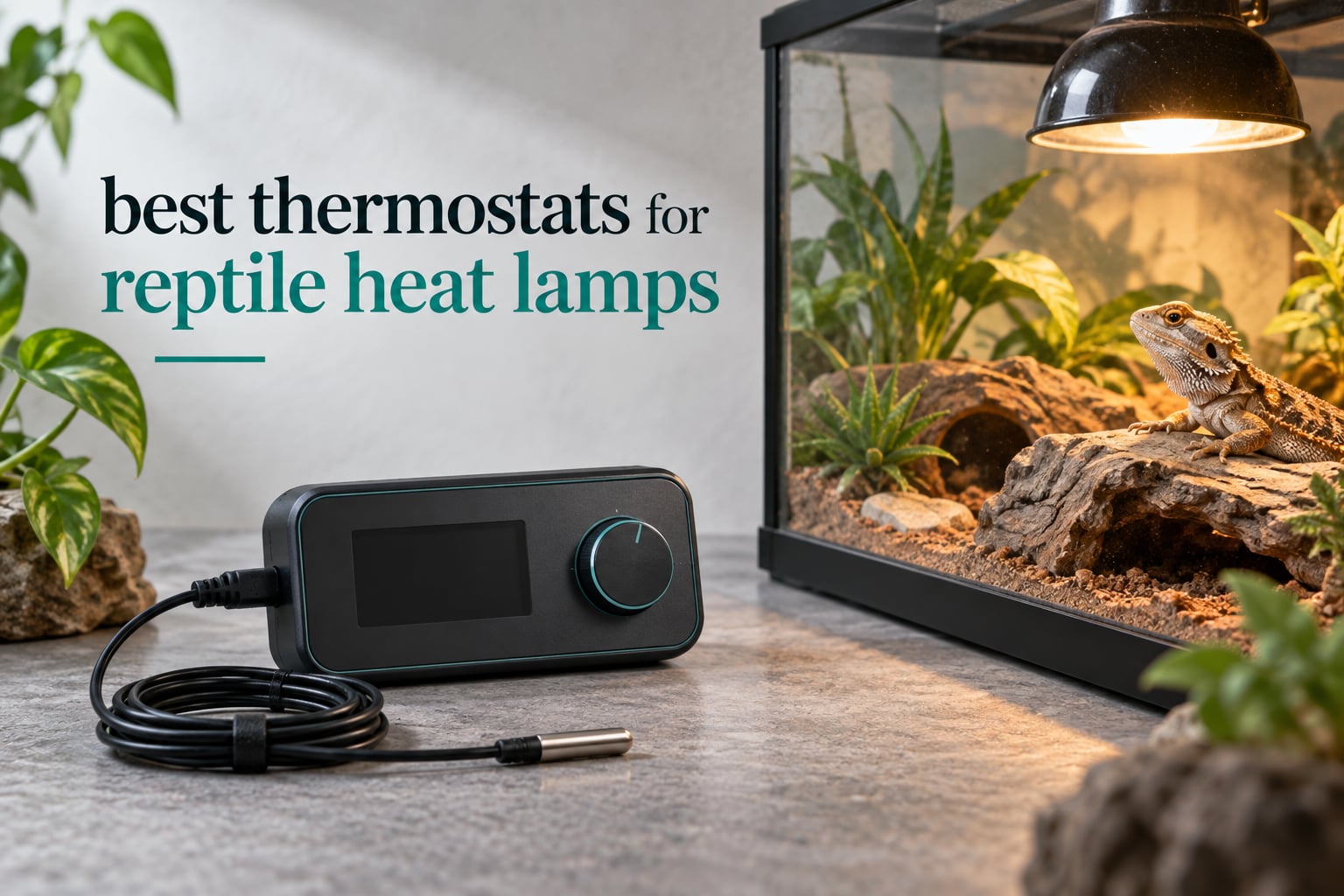
Most of the roundups on this topic make one mistake: they list ten cheap on and off controllers and then tell you not to bother with a dimmer. That advice is fine for a heat mat taped under a leopard gecko tank and wrong for a 150 watt halogen dome over a ball python. Here is the short answer before anything else.
A reptile heat lamp that produces visible light needs a dimming or pulse proportional thermostat. Those two methods reduce power as the probe temperature climbs, so the bulb stays lit and runs cooler. On and off controllers cut power completely, which works for ceramic heat emitters, heat mats and heat cables but shortens the life of every incandescent and halogen bulb you own. For the darker heat sources, an on and off controller is fine and costs a fraction as much.
That distinction is the whole guide below. I compared twelve controllers built for terrariums, focusing on the ones that can actually drive a lamp rather than only a mat, and I read the owner feedback closely on probe drift, wattage ceilings and early failures. Everything in this list of the best thermostats for reptile heat lamps is matched to a specific heat source, so you can start from your bulb and work backwards to the controller.
Two things worth setting up first. If you are still choosing the lamp itself, our guide to the best reptile heat lamps covers which bulb types suit which species. And if your setup is bigger than a single tank, the best reptile terrarium controllers guide covers multi zone and rack style units in more depth than this one can.
One more framing note. Reptiles are ectotherms, so every degree in the enclosure is a degree their body has to fight for. An unregulated lamp in a small plastic tub can climb past safe basking temperatures within an afternoon. A thermostat is not an upgrade here, it is the bare minimum.
Top 3 Picks for Reptile Heat Lamps (October 2026)
These three are the ones I would actually buy first, depending on what you are running. The BN-LINK leads on proof: it carries the largest review base in this entire group and holds within a couple of degrees when the probe is placed properly. The Zoo Med ReptiTemp is the pick if alarms matter to you, and the dual outlet Inkbird is the one to buy when you have two enclosures and want phone monitoring.

BN-LINK Digital Reptile Thermostat
- 1000W max load
- 40-108F range
- ETL listed
- On and off control

Zoo Med ReptiTemp RT-600
- 600W heating
- 50-122F range
- Audible high and low alarm
- Heat and cool modes
Inkbird IPT-2CH WiFi Dual Outlet
- Two independent outlets
- 250W per outlet
- WiFi app monitoring
- Two probes included
Every Pick at a Glance in 2026
All twelve controllers, with the control method, the wattage ceiling and the heat source each one suits. The dimming and pulse proportional models are the ones built for lamps that glow.
| Product | Specifications | Action |
|---|---|---|
| BN-LINK Digital Reptile Thermostat |
|
Check Latest Price |
| Zoo Med ReptiTemp RT-600 |
|
Check Latest Price |
| Inkbird IPT-2CH WiFi Dual Outlet |
|
Check Latest Price |
 REPTI ZOO TC02 Dimming Thermostat REPTI ZOO TC02 Dimming Thermostat |
|
Check Latest Price |
 Zilla Digital Temperature Controller Zilla Digital Temperature Controller |
|
Check Latest Price |
 SENSTREE Three Outlet Controller SENSTREE Three Outlet Controller |
|
Check Latest Price |
 REPTITRIP SOP24 Lighting and Heat Timer REPTITRIP SOP24 Lighting and Heat Timer |
|
Check Latest Price |
 CAVACHEW PID Dimming Thermostat CAVACHEW PID Dimming Thermostat |
|
Check Latest Price |
 REPTITRIP PT02 Dimming Thermostat REPTITRIP PT02 Dimming Thermostat |
|
Check Latest Price |
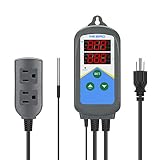 Inkbird ITC-306T WiFi Thermostat Inkbird ITC-306T WiFi Thermostat |
|
Check Latest Price |
 ReptiKing X100 Dimming Thermostat ReptiKing X100 Dimming Thermostat |
|
Check Latest Price |
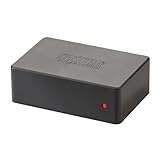 Exo Terra Dimming and Pulse Thermostat Exo Terra Dimming and Pulse Thermostat |
|
Check Latest Price |
1. BN-LINK Reptile Thermostat – Best Overall
BN-LINK Reptile Thermostat Temperature Controller, Digital Heat Mat Thermostat for Seed Starting, Plant Germination, Greenhouse, Incubator, Brooder, Brewing, Reptiles Tank,40-108°F, 1000W, ETL Listed
1000W max load
40-108F control range
4.92 ft probe
ETL listed,heating only
Pros
- Largest review base in this group
- holds within 1-2 degrees with correct probe placement
- 1000W ceiling covers multiple heat sources
- ETL listed
- long probe and power cord
Cons
- On and off control cannot dim a heat lamp
- No high or low temperature alarm
- Reading depends entirely on probe placement
- A small number of reports of units failing after extended use
I have this one sitting in rotation across two enclosures and it has never made me think about it. The spec sheet is unremarkable in the best way: a 40 to 108 degree control range, a 1000 watt ceiling at 120 volts, and a 4.92 foot probe that reaches the back of a standard 20 gallon long tank without a fuss.
Owners across a review base of nearly twenty thousand report the same thing, which is that the perceived temperature errors are almost always probe placement rather than the controller. A probe buried under a water dish or touching the glass will read high and the lamp will shut down early, and the keeper assumes the thermostat is broken.
The 1000 watt capacity is the underrated part. Almost every controller in this list tops out between 200 and 300 watts, which means a single 40 watt dome is fine but adding a second heat source means a second controller. This one has the headroom to run a mat and a lamp from the same relay if your setup needs it.
Setup takes about two minutes. Three buttons, program the set point, toggle between Fahrenheit and Celsius, and hang the box on the wall with the tab. The heating and power indicator lights are visible in a dark room, which matters if you check the tank at night.
What you should check before buying?
It is an on and off controller, so if your lamp is an incandescent basking bulb the bulb will power cycle and its filament life will be cut short. That is the tradeoff you accept for the price and the review base.
There is no alarm. If the probe fails, this controller does not have a documented auto shutoff, so a rack of tanks running on these needs a separate alarm bell or a smart plug.
Who it suits and who it does not?
Buy this for heat mats, heat tape, ceramic heat emitters and small to medium setups where wattage headroom matters. Leopard geckos, crested geckos, ball pythons on a single tank and juvenile snakes all fall into that group.
Skip it if your primary heat is a halogen dome you want to run cool and long, or if you are building a multi tank rack and need one alarm per zone.
2. Zoo Med ReptiTemp RT-600 – Best for Alarms
Zoo Med ReptiTemp Digital Thermostat
600W heating
50-122F range
6 foot sensor
Alarm plus power loss memory
Pros
- Recognizable herp brand with a long standing model number
- Audible and flashing high and low alarm
- Settings survive a power cut
- Heat and cool modes in one box
- 600W heating capacity
Cons
- On and off control so lamps cycle rather than dim
- Cooling capacity limited to 150W
- 6 foot sensor cable is shorter than some rivals
- Temperature swings when the relay switches
The ReptiTemp is the one I recommend to anyone running a rack or leaving the house for a weekend, because the audible alarm is the feature that separates it from every other budget controller here. When the reading leaves the range you set, it beeps and the display flashes.
It also has built in memory, so if the power drops in a storm the settings come back on restart instead of resetting to a factory default. On an unattended enclosure that is a meaningful safety difference, and it is the reason I keep one in reserve as a backup controller.
The 50 to 122 degree range covers everything from a tropical enclosure to a desert basking spot, and the 600 watt heating capacity handles a 60 watt ceramic emitter with plenty of margin. There is a cool mode too, which is the only cooling function anywhere in this roundup alongside the SENSTREE, and it handles up to 150 watts of fan.
The model number, RT-600, is a long standing platform and support parts are easy to source. For a first herp brand thermostat the name means something to beginners, which is not nothing when you are buying blind.
What you should check before buying?
It switches power on and off, it does not dim. Running a basking bulb through it means the bulb cycles, and owners who move to a dimmer later report steadier temperatures and longer bulb life as the two biggest upgrades.
The 6 foot sensor cable is shorter than the BN-LINK probe, so in a deep enclosure the probe may need to sit nearer the animal than you would like. Watch for that before you order.
Who it suits and who it does not?
This is the one for ball python and colubrid keepers with a multi day rack, or anyone who wants a controller that tells them something is wrong. The alarm plus memory combination is worth more than a fan output in most rooms.
It is a poor match for a bearded dragon or tortoise basking lamp if your main goal is long bulb life, and it will not drive a high output deep heat projector alongside another source at the same time.
3. Inkbird IPT-2CH WiFi – Best for Two Tanks
Inkbird WiFi Heat Mat Reptile Thermostat Controller Temperature Controller with 2 Probes and 2 Outlets, IPT-2CH Reptiles Heat Mat Thermostat (Max 250W per Outlet)
Two outlets and two probes
250W per outlet
WiFi app control
Heating only
Pros
- Two independent outlets and probes in one controller
- Check temperatures from your phone
- App charts and data export
- High and low alarms plus probe error alerts
- Good value for a two tank setup
Cons
- On and off control cannot dim a basking lamp
- Each outlet capped at 250W
- 2.4 GHz WiFi only so 5 GHz networks will not pair
- Heating only and cannot drive a cooling fan
Two enclosures, one controller, two independent probes. That is the pitch, and for a keeper with a couple of tanks on different heat sources it removes a whole shelf of hardware. Each outlet has its own set point and its own probe reading.
The app is the reason most people buy it. You get temperature charts you can export, high and low temperature alarms, and probe error alerts pushed to your phone, which means you find out about a failed sensor at work rather than at bedtime.
Keep the 250 watt per outlet ceiling in mind when you plan. A 150 watt halogen dome fits, but a 200 watt deep heat projector plus a 40 watt ambient dome on the same outlet does not. Split heavy loads across both outlets and it works well.
Owners of ball pythons and multi terrarium rooms consistently rate it as good value for the two channel design, and the general consensus is that the on and off cycling is perfectly acceptable for the heat mats this tends to get used with.
What you should check before buying?
It is 2.4 GHz only. If your router broadcasts 5 GHz on a separate network, the pairing will fail and you will spend an evening on it. Check your network band before you order.
It is heating only. There is no cooling output, so a summer afternoon in a warm room still needs a fan on a separate timer.
Who it suits and who it does not?
Two tank setups, quarantine tanks, or a single room where you want phone visibility without buying two controllers. It also works as a grow or incubation controller, since the relay logic is generic.
Do not buy it as your only controller for a lamp you care about, and do not try to run two high wattage heat sources through one outlet.
4. REPTI ZOO TC02 Dimming Thermostat – Best for Basking Bulbs
REPTIZOO Dimming Thermostat, PID Temperature Controller with Memory Function, Reptile Thermostat for Reptile Heat lamp, Specifically Designed for Light Heat Bulbs & Heaters
PID dimming
300W max output
41-140F range
Memory function and C/F switch
Pros
- PID dimming is the right match for incandescent basking bulbs
- Wide 41F to 140F set range
- Memory restores settings after a power cut
- Works with lamps mats and heat cable
- One year manufacturer warranty
Cons
- Lowest average rating in this roundup at 4.2 with a higher one star share
- A small differential can drop output very low so set points may need raising 3-5C
- Maximum output limited to 300W
- Not suitable for sunlamps or mercury vapor bulbs
This is the thermostat that answers the question in the title most directly. The TC02 uses PID dimming, which means as the probe reaches set point the power to the bulb is reduced rather than switched off, so the lamp stays lit and runs cooler than it would at full output.
That behaviour is the whole reason to buy it. Keepers who switch over from an on and off controller report smoother lamp output and steadier basking temperatures, and the visible flicker that comes with relay switching disappears.
The 41 to 140 degree range is the widest set range of any dimmer in this group, which means the same controller works for a tropical enclosure and a high desert reptile. Memory function restores your settings after a power cut, and you can switch the display between Celsius and Fahrenheit.
Worth reading carefully: the manufacturer states the probe should sit at least 15 centimetres from the heat source, and this controller is not for sunlamps. Put the probe in the warm zone, not against the dome, or the PID loop will chase its own tail.
What you should check before buying?
The 4.2 rating is the lowest average here and the one star share is comparatively high. Reports cluster around probe placement, a lack of built in alarms, and a small minority of units that stopped dimming after a few months of service.
Because PID control reacts proportionally, a small temperature difference can drive output very low. If you set a target just above your current reading, nothing appears to happen, so expect to raise set points by a few degrees while you calibrate.
Who it suits and who it does not?
Invisible light basking bulbs, dome lamps, and low to moderate wattage setups. It sits between the cheapest dimmers on this list and the established name brand units, which is exactly where most keepers should be looking.
Do not pair it with a mercury vapor or sun lamp, and do not expect it to drive a 500 watt deep heat projector.
5. Zilla Digital Temperature Controller – Best for Day and Night Cycling
Zilla Digital Temperature Controller, Thermostat for Reptile Terrariums
Programmable day and night settings
Probe with auto shutoff
Wall mountable
Undertank and ceramic sources
Pros
- Owners report readings matching separate thermometers within a fraction of a degree
- Programmable day and night settings
- Automatic overheating shutoff on the probe
- Long cord and wall mountable design
- Sells for far less than pet store pricing
Cons
- Basic on and off cycling with a single set temperature and no alarm
- Heating outlets use two prong rather than three prong plugs
- Unit and wiring are bulky
- One review reports a unit that stopped activating the heat source after about eight months
The Zilla is the one I would call the most accurate on and off controller here. Owners who own a decent infrared thermometer or a secondary probe report that its readings match within a fraction of a degree, which is close to what the manufacturers in this list claim as their accuracy spec.
Its selling feature is programmable day and night settings. You set a daytime target and a night target and the controller moves between them, which is what diurnal species need for a natural thermal rhythm rather than one flat temperature all day.
It is explicitly designed for non light emitting heat sources, so think under tank heaters, heat tape and ceramic emitters. The probe has an automatic shutoff for overheating, which is a different feature from probe failure shutoff but still a layer of protection.
Long term owners buy these in multiples and cite durability across years of service, which is why several of you will see experienced keepers using it as a starter or bridge controller before stepping up.
What you should check before buying?
The heating outlets use two prong plugs rather than three prong, and experienced keepers consistently flag that. If your rack is wired with grounded outlets you will need an adapter, and it is worth doing properly rather than leaving a loose connection on a constant heat source.
There is no alarm function, and the switching is basic on and off. The unit and its wiring are also bulky for a small enclosure wall.
Who it suits and who it does not?
Geckos, snakes and small to medium lizards on under tank heaters or ceramic emitters, and anyone who wants a night drop without a separate timer. The accuracy is the reason it lands here despite the basic switching.
It is not the right controller for a visible basking lamp if bulb life is the priority, and it will not tell you anything is wrong while you are away.
6. SENSTREE Three Outlet Controller – Best for Multi Zone Rooms
Reptile Temperature Controller, 3 Outlet Timer Thermostat for Grow Tent, Incubation, Snakes, Fish Tank, Heater, humidifiers, Ball Pythons, Bearded Dragon Tank
Two temperature zones plus one timed outlet
Each zone heats and cools
Two waterproof probes
High and low alarm with calibration
Pros
- Three independent outlets cover a hot side a cool side and a lighting circuit from one controller
- Each temperature zone can drive heating or cooling
- High and low alarms with calibration and cycle functions
- Two waterproof probes let you hold different setpoints
- Useful beyond reptiles for brooders and water heating
Cons
- Steep learning curve and a confusing manual that sends buyers to video guides
- Outlets 1 and 2 cannot run a timer on a lamp
- The internal clock has been reported to drift
- Several reviews describe probe or unit failure within a few months
The SENSTREE does something no other controller in this roundup does. It has two independent temperature controlled outlets that can each heat or cool, plus a third outlet on a 24 hour clock for lighting, all from one box with two waterproof probes.
In practice that means one enclosure can have a hot side and a cool side held at different set points while the UVB fixture runs on its own schedule. For a room with several setups that is genuinely fewer boxes on the wall.
Both temperature outlets handle heating and cooling, so a small fan can be triggered as the top side of the range, which is useful in a room that heats up in July. There is a high and low alarm, a cycle function, and temperature calibration, and the display toggles between Celsius and Fahrenheit.
Buyers consistently call the documentation the biggest hurdle. Several describe needing trial and error or a video walkthrough to get the two zones configured, so budget an hour the first time rather than ten minutes.
What you should check before buying?
The lamp timed outlet surprise catches people out. Outlets 1 and 2 are temperature controlled only, so if you want a basking lamp on a schedule you have to use outlet 3, and you cannot also get temperature control on that lamp.
The internal clock has been reported to drift, and several reviews describe a probe or the controller itself failing within a few months. One report mentions a near miss with a burning smell, which is a reminder to monitor any controller you have not tested yet.
Who it suits and who it does not?
Breeder rooms, incubation setups, multi enclosure rooms, and anyone who needs a cooling output alongside heating. Two independent set points from one unit is the feature you cannot get elsewhere at this level.
It is not for a beginner who wants to plug something in and forget it, and the 4.0 rating means the manual and the monitoring habit are part of owning it.
7. REPTITRIP SOP24 – Best for Combined Lighting and Heat
REPTITRIP Reptile Thermostat, Light Timer for Temperature and Lighting Control, Day-Night Timer Thermostat with Reptile Thermometer for UVB Light, Heat Lamp, Heating Pad, 10A 1250w
Timed socket S1 plus heat socket S2
1250W at 10A
32-140F set range
Replaceable probe at 2F accuracy
Pros
- Lighting timer and thermostat in one box cuts the wall clutter
- Three customizable timing programs on the lighting socket
- Day and night temperature setpoints
- High 1250W load at 10A
- Replaceable temperature probe
Cons
- On and off temperature control with no dimming
- Heating only so it cannot drive a cooling fan
- Probe accuracy of 2F is looser than most competing controllers
- Programming the timer and day and night mode takes practice
Most keepers end up with two boxes on the wall: one timer for the light and one thermostat for the heat. The SOP24 combines them in one. Socket S1 switches on a schedule with three customizable timing programs, and socket S2 switches by temperature independently.
The load rating is the quiet headline. 1250 watts at 10 amps is the highest capacity of any controller here, which means one 40 watt dome, one 80 watt incandescent and a heat mat can all run from socket S2 without strain.
The set range runs 32 to 140 degrees, wide enough for a tropical room and a desert basking spot on the same unit. The probe is replaceable if it gets damaged, which matters in humid enclosures where a permanently attached sensor is a liability.
Day and night temperature mode is built in, so you can set a cooler overnight target and let the light program handle the visible output. Reviewers who pair it with a UVB fixture like the scheduling side of it, the timer plus thermostat in one.
What you should check before buying?
Socket S2 switches power on and off, it does not dim, so a visible basking bulb will still cycle. The 2 degree probe tolerance is also looser than the BN-LINK or Zilla, so verify the reading against a secondary thermometer.
It is heating only. There is no cooling output, and the programming takes a couple of attempts to get right.
Who it suits and who it does not?
Any single enclosure that needs both a light schedule and temperature control, or a high wattage mat and ceramic combination that would strain a 300 watt controller.
Skip it if bulb longevity on a visible lamp is your priority, or if you need a cooling fan in summer.
8. CAVACHEW PID Dimming Thermostat – Best Budget Dimmer
CAVACHEW Dimming Thermostat Reptile, Thermostat for Reptile Heat Lamp Mats Bulbs, PID Temperature Controller for Reptile Amphibian Habistat, Memory Function, LED Digital Screen, Sensitive Probe, 300W
PID dimming
300W max output
68-122F range
Memory function with C/F display
Pros
- Lowest priced true dimming PID controller in this group
- Memory function lets you pair it with a wall timer
- Dimming output gives steadier basking temperatures than on and off cycling
- Accurate with halogen and other basking bulbs
- Easy to install and program
Cons
- One review reports the unit melting and a fire after about a week of use
- Several reviews report flicker or shutdown within weeks
- Displays in Celsius so Fahrenheit users must convert
- Maximum output capped at 300W
True dimming control used to mean paying name brand money. This one is a PID dimmer with a 300 watt ceiling, a 68 to 122 degree range, and a memory function, for a fraction of what the established brands cost. If your budget is the constraint and your lamp is a basking bulb, this is the honest entry point.
The memory function is more useful than it sounds. Because it restores your set point after a power cut, you can put it on a wall timer for the light and let the thermostat resume exactly where it was instead of resetting to a default.
Owners buy these in multiples and describe the dimming behaviour as noticeably smoother than on and off cycling, with halogen bulbs in particular responding well. The LED screen shows ambient and set temperature with a switchable unit.
Now the part you need to weigh honestly. A small but serious group of reviews reports early electrical failure, including one account of the unit melting and a fire after about a week. Several others describe flicker or shutdown within weeks. That is a real durability concern, not a rounding error.
What you should check before buying?
Stay with it the first week and check it daily. This is the one product here where I would not recommend leaving a new controller unattended in a rack until you have confirmed it is stable.
The display is in Celsius, so if you think in Fahrenheit you are converting constantly. Maximum output is 300 watts, so a single 150 watt halogen fits but a second source on the same outlet does not.
Who it suits and who it does not?
One enclosure, one basking lamp, a tight budget, and a keeper who will check the setup regularly. It is a good way to get dimming behaviour before spending on a higher priced controller.
It is not for an unattended room, a rack, or a setup where a failure means a burned animal. Weigh that against the saving honestly.
9. REPTITRIP PT02 Dimming Thermostat – Best for Ceramic Emitters
Reptile Thermostat, Dimming Thermostat with 1-24H Timer Setting
PID dimming with 1-24 hour timer
260W max output
50-140F range
LCD shows live output power
Pros
- Dimming holds temperature within about 1-2 degrees instead of waiting for a large swing
- Timer from 1 to 24 hours adds scheduling without a second device
- Backlight switches off after 20 seconds so there is no light spill at night
- Works with basking lamps and ceramic emitters
- Manufacturer has replaced failed units for buyers
Cons
- 260W maximum output is lower than most competing dimmers
- One review reports the unit dying with a burning smell after about three months
- Temperature calibration is not precise against a separate thermometer
- Suction cup probe holder can pop off the enclosure
- Only a two month manufacturer warranty
The PT02 is the dimmer I would pick for a setup that mixes a ceramic heat emitter with a basking lamp. It is a PID dimmer, so it holds within a degree or two instead of waiting for a full swing, and the manufacturer lists compatibility with heat mats, day and night heat lamps, infrared lamps and ceramic emitters.
The LCD is unusually informative for the money. It shows real time output power alongside ambient temperature, so you can watch the dim percentage climb or fall and learn what your enclosure actually needs rather than guessing.
The backlight switches off after twenty seconds, which is a small thing that matters in a nocturnal species enclosure or a dark bedroom. The 1 to 24 hour timer adds scheduling without a second box, and the 50 to 140 degree range covers both tropical and desert targets.
Keepers moving up from an on and off controller report a clear improvement in stability and frequently buy multiples. The brand has also been responsive with replacements, including for buyers outside the return window, which softens the durability complaints considerably.
What you should check before buying?
The 260 watt ceiling is the real constraint. A single 80 watt ceramic emitter or a 100 watt halogen is fine, but pairing a CHE and a dome on one output will not work, and the manufacturer is explicit that it is not for UVB, LED or sun lamps.
The calibration is not precise against a separate thermometer, so budget for an offset check. The suction cup probe holder can also pop off a glass front, which is a bad failure mode on an enclosure where the probe position is everything.
Who it suits and who it does not?
One enclosure with a ceramic emitter, a nocturnal setup where the backlight matters, and anyone who wants dimming plus a timer without two devices.
Not for high wattage halogen domes above 150 watts, not for a rack, and note the two month manufacturer warranty when you register it.
10. Inkbird ITC-306T WiFi – Best for App Monitoring
Inkbird Temperature Controller ITC-306T WiFi Heat Lamp Thermostat Reptile Temperature Controlled Outlet for Heat Mat Fermentation,1200W,10A.
WiFi app control
1200W at 10A across two outlets
Dual digital display
Two cycle timers in 24 hours
Pros
- High 1200W and 10A capacity covers multiple heat sources such as heat tape strips
- App monitoring gives peace of mind away from home
- Temperature differential plus two cycle timers allow a night drop schedule
- Large red numbers readable from several feet
- Keeps operating standalone if WiFi drops and settings survive a power cut
Cons
- Instruction manual is widely criticized and many buyers rely on third party videos
- On and off control rather than proportional dimming
- Probe is permanently attached and cannot be replaced or routed through a small hole
- One unit developed an Err display and locked up
- Power cord could be longer
This is the Inkbird with more headroom than the dual outlet model. Two outlets, 1200 watts and 10 amps total, and the app shows temperature graphs with alarms and a timer. Reviewers highlight that it keeps working as a standalone controller if the WiFi connection drops, so the convenience is not a dependency.
Two cycle timers within 24 hours plus a temperature differential setting is what makes it useful for a species that needs a real night drop. You set the daytime target, set the overnight offset, and the controller handles both without a second device.
The red display numbers are large enough to read across a room, which sounds minor until you are checking a rack at midnight without waking up the enclosure with a flashlight. The dual display shows measured and set temperature at the same time.
Reliability is the strength once it is configured. Inkbird support has replaced defective units promptly, which several owners mention directly and which matters more than any spec line.
What you should check before buying?
The manual is the weak point and is criticized across reviews, so plan on a third party setup video rather than the included booklet. The probe is permanently attached, which means it cannot be replaced when it eventually fails and cannot be routed through a small cable slot.
It is on and off control, so a basking lamp cycles rather than dims. One unit also developed an Err display and locked up, and the low temperature alarm floor starts at 58 degrees, which is fine but worth knowing.
Who it suits and who it does not?
Anyone running more than one heat source, breeding racks, incubation and grow setups, and keepers who travel and want the app to tell them what is happening overnight.
Not for a single small enclosure, where the app adds cost you will not use, and not for a visible basking lamp you want to run long.
11. ReptiKing X100 Dimming Thermostat – Best for Small Enclosures
ReptiKing Reptile Dimming Thermostat, Heat Lamp Temperature Controller, Reptile Terrarium PID Digital Thermostat, Heating Controller for Basking Spot Heat Bulbs and Ceramic Heat Emitter
PID dimming
200W max load
68-122F set range
UL certified power cord
Pros
- PID dimming avoids the on and off temperature swings of cheaper controllers
- Manufacturer states lamp life can extend by up to 45 percent
- Simple hookup with a female socket and suction cup probe
- Clear digital display of real time terrarium temperature
- One year manufacturer warranty
Cons
- 200W maximum load limits it to smaller basking bulbs and single emitters
- Set range tops out at 122F so it cannot serve high temperature reptiles
- Heating only with no alarm function
- Not compatible with UVB or mercury vapor bulbs
The ReptiKing is a small dimmer for a small enclosure. Installation is about as simple as it gets: the lamp fixture plugs into the female socket on the controller and the suction cup probe sticks to the glass where you want the reading.
The dimming is the point. Owners of geckos and small lizards report noticeably smoother temperature behaviour than on and off controllers, and the manufacturer claims dimming can extend lamp life by up to 45 percent, which is the same physics argument that applies to every dimmer in this list.
Its constraints are what decide whether it fits. The maximum load is 200 watts, so one 40 to 80 watt basking bulb or a single ceramic emitter is the realistic ceiling, and the set range tops out at 122 degrees, which rules out the high temperature reptiles.
The power cord is UL certified, which is worth noting on any device that sits next to a constant heat source. There is a one year manufacturer warranty, longer than the two months offered on the REPTITRIP PT02.
What you should check before buying?
Confirm your bulb wattage before you order. If you are running a 150 watt halogen you need a higher output controller, and this one will not carry it.
There is no alarm and no cooling output, and it is explicitly not for UVB or mercury vapor bulbs. The 122 degree ceiling also means it cannot serve a uromastyx or desert iguana style high heat setup.
Who it suits and who it does not?
Small gecko and lizard enclosures with a single modest basking bulb, and beginners who want dimming behaviour without a complicated setup.
Skip it for high heat species, for anything over 200 watts, and for a rack where you need monitoring.
12. Exo Terra Dimming and Pulse Proportional Thermostat – Best for Pulse Control
Exo Terra Dimming and Pulse Proportional Thermostat for Reptile Terrariums
Dimming and pulse proportional modes
300W max load
64-100F range
Waterproof remote probe
Pros
- Offers both dimming and pulse proportional modes so it suits bulbs or low wattage mat setups
- Very responsive to small changes and holds within a degree or two
- Recessed dial makes accidental setting changes unlikely
- Waterproof remote probe is a plus in humid terrariums
- Established brand with a widely recognised support network
Cons
- Most expensive controller in this roundup
- Control range tops out at 100F so it cannot serve reptiles needing a hotter basking spot
- 300W ceiling
- Reported not to hold temperature with deep heat projectors in dimming mode
- One review reported the unit arrived looking second hand
The Exo Terra is the only controller here that gives you both control methods in one box. A dial selects dimming for a lamp or pulse proportional for a low wattage mat or ceramic setup, so one device covers two heat sources in the same room.
That flexibility is why keepers name it. It is also the most expensive pick in this list, and the recessed dial is a genuine safety feature, because a protruding knob is one you can knock with a spray bottle and change the set point of a living enclosure.
The waterproof remote probe matters more than it sounds in a tropical setup with a mister running, which is exactly where probe failure is most common. The red LED shows when the heating device is energised, and control range is 64 to 100 degrees.
Owners of leopard geckos and similar moderate temperature species report smooth, accurate control and appreciation for having both modes available. It controls heating devices up to 300 watts, covering heat mats, heat cables, ceramic heaters and incandescent bulbs.
What you should check before buying?
The 100 degree ceiling is the hard limit. If your animal needs a basking spot above that, this controller physically cannot deliver it, no matter how well it performs on a moderate temperature species.
There are documented reports of difficulty holding temperature with high output deep heat projectors in dimming mode, and it is the most expensive option here, so be certain the range suits your species before committing.
Who it suits and who it does not?
Moderate temperature species on a moderate budget who want one controller that handles both a lamp and a mat, and humid enclosures where probe waterproofing is a priority.
Not for desert reptiles needing a very hot basking spot, not for a 500 watt class projector, and not for a keeper buying on a tight budget.
Thermostat Types Explained Before You Buy
Every controller in this list is one of four things, and the differences are not marketing language. They describe how the relay responds as the probe reading approaches your set point, which is what determines bulb life, temperature swing and how noisy the setup looks in a dark room.
On and off thermostat. The simplest method and the cheapest. The controller switches the heat source fully on below set point and fully off above it. There is no intermediate state, so a basking lamp cycles hard between two temperatures and the bulb takes repeated thermal shock every cycle. Perfectly correct for heat mats, heat cable and ceramic heat emitters, where there is no filament to protect and the temperature swing is absorbed by substrate.
Dimming thermostat. The controller reduces the power to the heat source as the probe reaches set point, so the bulb dims rather than switching off. The lamp stays lit, the basking spot changes gradually, and the filament is not repeatedly shocked. This is the correct method for any heat source that produces visible light, and it is what separates a purpose built lamp thermostat from a mat thermostat.
Pulse proportional thermostat. The controller switches the heat source very rapidly on and off, so fast that the average power delivered matches what the temperature calls for. A high wattage lamp may be driven at full output for a second and off for a second, and the animal does not perceive it. Pulse control suits higher wattage fixtures and, on some units, ceramic emitters where dimming is not applicable.
Rheostat or dimmer switch. A manual control with no temperature feedback at all. You turn it to a level and it stays there. It is not a thermostat and should not be sold to you as one, but you will encounter it in lamp fixtures and it is worth recognising so you do not mistake a dial for temperature control.
Two settings apply across all of these. The set point is the temperature you are asking for, and the differential is the band either side of it that the controller allows before acting. On a dimmer a narrow differential gives fine control and a smooth lamp; on an on and off controller the same narrow differential means many switch cycles an hour, which is exactly the pattern that kills basking bulbs.
Every one of these reads temperature from a probe, and that probe is the weakest link in the system. A probe against glass, under a hide, or submerged reads nothing like the zone your animal occupies, and no controller can correct for where it is installed. Probe placement matters more than the brand name on the box.
How to Match a Thermostat to Your Heat Source?
Start from the heat source, not the price. The controller type that is right for a halogen dome is actively wrong for an under tank heater, and the reverse is also true. Here is how the five common heat sources map to the right kind of controller.
Do basking lamps and halogen domes need a thermostat?
Yes, and they need a dimming or pulse proportional one specifically. A lamp that emits visible light should never be run flat out all day, and it should never be switched on and off in cycles either, which is the middle path that a dimmer removes.
The reason is filament life. Halogen and incandescent filaments fail when they are heated and cooled rapidly, and a relay switching a bulb on and off several times an hour repeats that thermal shock continuously. Keepers report bulbs dying far earlier than rated, and the standard fix in keeper communities is a dimmer for any heat source that glows.
Dimming has a second benefit. Because the controller reduces power rather than cutting it, the basking spot temperature changes gradually and the animal is not stepping between a hot plateau and a cooler plateau every few minutes. It is a steadier environment, not just a cheaper bulb.
Ceramic heat emitters, mats and cables
These produce no visible light, so there is no bulb to protect. An on and off controller works correctly here, and it is cheaper and simpler. For a heat mat under a leopard gecko tank, an on and off controller is genuinely the right answer and there is no reason to spend more.
Watch the wattage. Under tank heaters and heat cable runs draw more than most small lamps, so match the load and give yourself headroom. A 40 watt mat and a 40 watt ceramic emitter on the same 100 watt controller leaves no margin for anything else.
How much wattage do you actually need?
Add up the wattage of everything on the relay and then add roughly half again. A 150 watt halogen dome on a 200 watt controller leaves too little headroom for a second source or a hot summer afternoon, and a controller working near its ceiling runs hotter and shorter lived.
Range matters as much as wattage. Several of the dimmers in this list cap out at 122 degrees, which is fine for a leopard gecko and useless for a desert reptile. Check the maximum set point against your species before anything else.
Day and night cycling for diurnal species
Bearded dragons, tortoises and most lizards benefit from a genuine drop at night rather than a flat temperature. A programmable controller or one with a built in timer handles that, and the Zilla and REPTITRIP SOP24 are the two picks here built around that behaviour.
A cheaper approach is a good thermostat plus an external wall timer on the lamp, which works because the dimmers in this list with a memory function restore their set point when power returns. If you use that trick, verify the memory function before you rely on it.
On bulb wattage for bearded dragons specifically, a 75 watt lamp is usually on the lower side of what a healthy adult needs for a proper basking spot. Check the temperature at the basking surface with an infrared thermometer before settling, rather than trusting the wattage label.
Rack systems and one thermostat per enclosure
The short answer is one per enclosure. Shared controllers create a single point of failure, and a probe failure or a seized relay takes out a whole column of animals at once. If your budget forces a compromise, put the shared controller on the lowest risk enclosures and give the high risk ones their own.
For a multi tank room, the dual outlet controllers are genuinely useful because you get two independent probes from one wall box, but two animals still depend on one power supply. An alarm bell in the room is cheap insurance, and it is the feature most keepers underrate.
Where the room has several enclosures, the commercial heat lamp options we cover separately change the calculation, since higher output fixtures need far more controller headroom than a single dome.
Matching the set range to the species
The set range ceiling matters more than most buyers expect, and it is where dimmers split sharply. Several units in this list top out at 100 or 122 degrees, which covers leopard geckos, crested geckos, ball pythons and most snakes comfortably but leaves no margin for a desert reptile that needs a genuinely hot basking surface.
Check three numbers before you buy: the maximum set point of the controller, the wattage of your lamp, and the target temperature at the basking surface measured with an infrared gun. If your required basking temperature is at or above the controller ceiling, the unit is wrong regardless of how well it reviews.
One common piece of bad advice worth flagging: crested geckos and other tropical species generally do not need a basking lamp at all. Room temperature with a heat mat for juveniles during winter is the usual setup, which means an on and off controller is not a compromise for them, it is the correct tool.
Species starting points and which controller fits
These are starting points to measure from, not rules to skip verification with. Every animal is an individual and a hot room or a cold room changes what your enclosure needs, so treat the basking number as the figure you confirm with an infrared thermometer on day one.
Leopard gecko. Roughly 88 to 92 degrees at the warm end with a gentle drop at night. A 40 watt dome in a 20 gallon long tank is a common pairing, which every dimmer in this list will carry comfortably, and the on and off controllers work too if the bulb is not a concern.
Ball python. A warm side around 88 to 92 degrees with a cooler hide on the other half of the enclosure. Most keepers run either a ceramic heat emitter on a thermostat or a dimmed dome, and the 1000 watt BN-LINK and the dual outlet Inkbird are the practical choices for a two tub setup.
Bearded dragon. A basking surface in the low 100s, which is where set range ceilings start to matter. Several dimmers here stop at 122 degrees and that is acceptable, but anything that stops at 100 degrees is not, which rules the Exo Terra out of this species entirely.
Crested gecko and other tropical geckos. No basking lamp required in most setups. Room temperature with moderate humidity is the target, and for hatchlings a low wattage mat on an on and off controller with a thermostat in the enclosure is the standard arrangement.
Tortoise and desert species. High daytime basking temperatures with a pronounced night drop, and this is where day and night programmable controllers earn their place. The Zilla and the REPTITRIP SOP24 both handle the two set points without a second device.
Across all of these, the controller choice follows the same rule: check the maximum set point against the hottest surface your species needs, then check the wattage ceiling against everything you intend to run.
Where the premium brands sit?
You will see Herpstat, Microclimate, Vivarium Electronics, Habistat and Helix recommended constantly in keeper communities, and in our reading those names came up in almost every thread about lamp control. They are the units experienced breeders reach for on multi zone racks where long term reliability matters more than first cost, and none of them appear in this list.
The reason is load ceiling and output count. The established pro controllers commonly handle higher wattage, run multiple independent outputs from one box, and pair dimming with pulse proportional in the same enclosure controller, which is the same flexibility the Exo Terra offers at a smaller scale.
Whether the step up is worth it depends entirely on your setup. One tank and one dome does not need it. A ten tub ball python rack with dimming on day and pulse at night is exactly the case those units were built for, and a small controller per tub is a lot of wall space to waste.
How to Set Up a Heat Lamp Thermostat?
Every controller here follows the same five steps, and doing them properly is what separates a stable enclosure from one that swings all night.
1. Place the probe first. Position it in the area where the temperature actually matters, which for a basking setup means in the warm zone at animal height, not against the glass, not under a water bowl, and not touching the fixture. Manufacturer guidance for the dimmers here generally calls for at least 15 centimetres of clearance from the heat source.
2. Set the target temperature. Start slightly below the temperature you actually want and let the enclosure settle, because a probe installed in a cold tank will overshoot on the first cycle. Check the basking surface with an infrared thermometer rather than trusting the enclosure air reading.
3. Set the differential. This is the band the controller allows either side of set point before it acts. A narrow differential on a dimmer means small adjustments and steady output; a wide differential on an on and off controller means fewer switch cycles but more temperature swing for the animal.
4. Wait out the stabilisation window. Give the enclosure several hours, ideally overnight, before judging performance. A controller that looks wrong in the first hour is usually still reacting to a cold room.
5. Verify with a second thermometer. Every reliable answer in the keeper communities is the same: check the controller reading against a separate thermometer or an infrared gun, and aim to be within about one degree. If they disagree, apply a calibration offset rather than swapping the probe blindly.
Two mistakes show up repeatedly in setup guides. The first is putting the probe at the top of the enclosure near the screen top, where it reads a completely different temperature from the zone the animal occupies. The second is setting the target before the lamp has been on long enough to stabilise, then panicking and lowering the set point because the enclosure is still cold.
A third, quieter issue is lamp placement relative to the probe. If the probe sits where the lamp warms it before the rest of the enclosure, the controller will cut output early and the basking spot will sit cooler than the display claims. Move the probe rather than lowering the set point.
When you should start over rather than adjust?
If you have followed every step above and the enclosure still swings several degrees, the problem is usually the heat source rather than the controller. Too small a fixture in a large enclosure, a lid that loses too much heat overnight, or a room that is itself cooling at night will all defeat a perfectly good thermostat.
The other reason to change equipment is bulb life. If you are on an on and off controller and your basking bulbs are dying every few months, that is the expected behaviour of relay cycling, not a fault. Moving to a dimmer is the fix, and it is the single largest quality of life change in this whole guide.
If you have not already picked your fixture, our UVB lighting guide covers the other half of a proper diurnal setup, since a thermostat handles heat and not ultraviolet output.
Safety Features That Matter on an Unattended Setup
Once the enclosure is stable, the question shifts from performance to failure. These are the features that determine what happens at 2am when you are asleep and the probe fails.
High and low temperature alarms. An audible alarm is the cheapest safety feature available and the one most often missing. The Zoo Med ReptiTemp and the SENSTREE have one; the BN-LINK, the Zilla and the ReptiKing do not. On a rack, an alarm bell in the room can cover the gaps.
Probe failure auto shutoff. Some controllers detect a shorted or disconnected probe and stop powering the heat source. Others fail open and keep the relay closed, which means a failed probe becomes an unregulated heat source. Check the manual for your specific model rather than assuming.
Fails open versus fails closed. A fails open controller powers down when it loses control, which is safe. A fails closed controller keeps power on. Neither is wrong in every case, but you should know which one you own, because it determines your emergency plan.
Load headroom and certification. Do not run a controller at its rated maximum. Look for ETL or UL listing on a device that sits next to a constant heat source, and note that the BN-LINK is ETL listed and the ReptiKing ships with a UL certified power cord.
Memory and restore behaviour. A controller that forgets its set point during a power cut is a controller that comes back wrong. Memory function appears on the Zoo Med, the REPTI ZOO, the CAVACHEW and the REPTITRIP PT02.
Redundancy for winter. A backup alarm on a battery and a way to check temperatures remotely covers the case no single thermostat can, particularly in a room that drops below freezing during an outage.
What To Do If a Controller Fails Overnight?
This is the scenario that keeps experienced keepers up, so it is worth a short plan you can follow without thinking. A thermostat that stops responding is a medical urgency for a reptile, and the response differs depending on the season and the species.
If the room is cold and the animal is a tropical species. A ball python, python or tropical gecko can take a drop into the sixties for a night without harm, but a bearded dragon, tortoise or desert reptile cannot. Warm air from a room heater held at a distance, not aimed at the enclosure, is the safer first move than a hot lamp left running unsupervised.
If the room is hot and the animal is a temperate or desert species. Shut off the heat source at the wall, move water into the enclosure if it is safe to do so, and ventilate the room. A sprayed or misted enclosure can bring the surface temperature down quickly while you source a replacement controller.
What to look for in the morning. A reptile that has been too hot tends to hide, gape, or stay pressed into a cool corner with an unusually high basking temperature reading. One that has been too cold is lethargic and unresponsive when lifted. Both are reasons to see a reptile vet rather than assume the animal will bounce back on its own.
Before the next night. Replace or reset the controller, verify the probe reading against a second thermometer, and only then reattach the heat source. Half working protection is worse than none, because it encourages you to check less often.
If a controller failure is likely to repeat, that is the signal to move up a tier rather than buy the same unit again. A dimmer with a memory function, a controller with an audible alarm, or a unit from a brand that honours warranty support are all reasonable responses to a device that has already let you down once.
Frequently Asked Questions
What is the best thermostat for reptile heating elements?
For a heat lamp that emits visible light, the best thermostat is a dimming or pulse proportional model, because it reduces power as the probe temperature rises instead of cutting power entirely. On and off controllers are correct for ceramic heat emitters, heat mats and heat cables, which do not have a bulb to protect.
Do I need a thermostat for a heat lamp?
Yes. An ectothermic animal cannot regulate its own body temperature, and an unregulated lamp in a small enclosure can climb past safe basking temperatures within hours. A dimming thermostat also extends bulb life by avoiding the rapid on and off cycling that cracks filaments.
What is the best dimming thermostat for reptiles?
The Exo Terra is the most established option and the only one here offering both dimming and pulse proportional modes. For tighter budgets the REPTI ZOO TC02 gives PID dimming with a wide 41F to 140F range, and the REPTITRIP PT02 adds a built in timer. For the lowest cost, the CAVACHEW is a true dimmer but carries durability reports you should weigh.
Can you use a reptile thermostat with a basking lamp?
You can, but the control method matters. A dimming or pulse proportional thermostat is the right match for an incandescent or halogen basking lamp because the bulb stays lit and runs cooler. An on and off controller will power cycle the lamp, which shortens filament life and creates temperature swings.
How long do you leave a heat lamp on for a lizard?
Most keepers run the lamp on a 10 to 12 hour daylight cycle and let the temperature drop at night, which is why a programmable controller or a timer pair is useful. Diurnal species do best with a clear basking period and a cooler night, while nocturnal species need the opposite pattern.
What happens if my reptile thermostat stops working?
It depends on the failure mode. A fails open controller stops powering the heat source, while a fails closed unit keeps the relay closed and the enclosure heats unchecked. Check your manual for which one you have, keep a second thermometer in the enclosure, and put an alarm on any rack that runs while you sleep.
How accurate should a reptile thermostat be?
Within about one degree of a separate thermometer is a reasonable target. The Zilla is the most accurate on and off controller in this group by owner reports, while the REPTITRIP SOP24 has a stated probe tolerance of 2F, which is looser. Always verify the reading after installation and apply a calibration offset if needed.
The Verdict for 2026
Across most setups the single safest pick is the BN-LINK, which takes the Editor’s Choice slot for its 1000 watt ceiling, huge review base and ETL listing, and it is the one I would put behind a mat, a cable run or a ceramic emitter without hesitation. The Zoo Med ReptiTemp earns its place right behind it for the audible alarm, and the Inkbird dual outlet model is the pick when you have two tanks and want phone monitoring.
If your heat source produces visible light, change the method rather than the budget. The REPTI ZOO TC02 is the balance point most keepers should start at, the REPTITRIP PT02 is the one to add if you also run a ceramic emitter, and the Exo Terra is the established name brand option if you want dimming and pulse proportional in the same box.
Whichever one you settle on, place the probe before you set anything, give the enclosure a full night to stabilise, and confirm the reading against a second thermometer. That habit catches more real problems than any spec on the box.